You are about to leave the Capital Bank Website

DISCLAIMER: When you click Accept you will be leaving the Capital Bank (“the Bank”) website and are going to a website that is not operated by the Bank. We are not responsible for the content or availability of linked sites.

ABOUT THIRD PARTY LINKS ON OUR SITE
The Bank offers links to other third party websites that may be of interest to our website visitors. The links provided in our website are provided solely for your convenience and may assist you in locating other useful information on the Internet. When you click on these links you will leave the Bank’s website and will be redirected to another site. These sites are not under control of the Bank. The Bank is not responsible for the content of linked third party websites. We are not an agent for these third parties nor do we endorse or guarantee their products. We make no representation or warranty regarding the accuracy of the information contained in the linked sites. We suggest that you always verify the information obtained from linked website before acting upon this information. Also, please be aware that the security and privacy policies on these sites may be different than the bank’s policies, so please read third party privacy and security policies closely. If you have any questions or concerns about the products and services offered on linked third party websites, please contact the third-party directly.

Bridge Gaps Before They Happen

President Dwight D. Eisenhower famously said, “Plans are useless, but planning is indispensable.” When you’re running a business or organization, it can be difficult to find the time to step back and look at your operations, goals and opportunities. In fact, it’s easy to fall into doing the same thing over and over without realizing it. Yet taking a moment to reassess your long-term vision can be very meaningful, especially at the beginning of a new year. Personally, I like to take the time to reflect on what’s driving our sales and Key Performance Indicators (KPIs). I’ve also found there are a few other things to stay on top of.

When it comes to cash flow, timing is everything.

Cash is king, but it can also be elusive. The Small Business Administration (SBA) reports that 25% of small businesses fail due to cash flow challenges. Many times the problem isn’t a lack of money, but a disconnect in timing. You may need to lay out money before sales happen, and that can create a significant financial challenge. How do you pay suppliers before you have cash in hand? Do you raise equity? Get a loan? Bring in other investors? You may find you have capital gaps you’ll need to bridge and loans can take months to process.   It’s important to be well prepared to determine what, when and how — what you need, when you need it and how you will pay it back.

Be vigilant, watch these three cash-flow metrics.

Entrepreneur.com outlines three of the most important cash flow considerations. “Inventory turnover” measures how long your inventory sits and occupies your cash flow. “Payment days” measures how long it takes for you to pay your vendors. “Collection Days” measures how long your business is waiting to get paid. Projecting for these metrics 12 months ahead and reassessing over time will keep you prepared and safe from cash-flow gaps.

Remember your resources.

Another thing to consider is your resources.  It’s easy to get caught up in the “if something has to get done, do it yourself” mentality. That can wear you out (physically and emotionally), and deny yourself valuable information and ideas. Your lawyers, advisors, bankers, family and friends are all leverage points. Have them work for you to get more done and provide input into progress or shortcomings. Often people in your network have helped others or experienced themselves some of the challenges you may be facing and will have time-saving insight.

Assess your Progress.

Throughout my career I’ve had the opportunity to try different timelines to ensure I’m reaching my goals. I have found that a 60-day cycle is best for reassessing goals and operations. Sixty days is enough to show progress (or not) and enable reflection before tweaking the plan or changing course. Longer than 60 days can allow inefficiencies to continue too long.

When reassessing goals, I’ve found it best to start with a review of your projections and estimations, then compare the plan versus the actual numbers.  Always look to identify what changes you should make in your projections and assumptions, and whether it’s valuable to change the plan you’ve built around them. Remember where you started and where you want to end. A lot can happen during that time, which can be ok, as long are you’re prepared.

Bridge your gaps.

Of course, it’s important to keep in mind that not everything will go right. So when thinking ahead, expect obstacles. But with solid planning in place, you can ensure you stay on the road that you always intended.

One-on-One: The Value of Listening to Your Clients

With the advent of the digital age, one-on-one conversation is becoming a thing of the past. With it has gone the fine art of listening — one of the most valuable tools for any relationship, both business and personal, using emails as a substitute for really listening and gathering feedback. In fact, if you fail to listen to your clients, you fall short in understanding their needs. That, in turn, can put you out of business — fast.

Why the deaf ear to clients? When you’re running a business, you’re busy — you have inventory, your books, and your employees, with product development always top of mind. You can become execution-minded and forget to take a step back and ask if you’re fulfilling the needs of your clients. What’s working and what isn’t, and why? What can make their jobs easier and their business more profitable?

Consultative Approach

Every client is unique with different needs. What works with one may not work well with another. Yet there’s no way to discern the differences without spending time listening — and learning. What you uncover may be enlightening to both you and the client.

Perhaps you can solve a challenge they didn’t recognize they had. Often, they are using your products on a day-to-day basis and can provide valuable insight into obstacles and what’s “needed and wanted.” They may share their opinion regarding competing products. What better way to help you boost your product and service offerings? A consultative approach may even set the stage for a long-term partnership, uncovering solutions that can contribute to their success in future projects.

Fact is, if you make a customer happy, loyalty and retention can be the next natural step in your relationship. Equally important, they can become a valuable center of influence, sharing their exceptional experience with colleagues.

Consumer-Drive Innovation

How do many organizations “listen” today? They gather focus groups that may be limiting, as they often lead to “group agreement” versus individual input, leaving the organization without any real data. Some financial organizations are creating programs where customers can sign up to give feedback and participate in pilots of new products and services. While this gives the clients a say in product development, it doesn’t cater to their individual needs. Conversely, a consultative, one-on-one approach helps the business ascertain what is needed on an individual basis, and move forward to develop solutions that address those needs.

Case in point, at Capital Bank, we designed and implemented a solution that allowed a national charitable organization to remotely scan check payments along with corresponding invoices, enabling greater efficiency and reduction in disparate systems. The impetus was a conversation to unearth the need, with the solution developed over a two-week period. Another conversation with a not-for-profit customer led to a solution that leverages data collected from remote deposit capture, creating a database of donors that could be electronically parsed between entities and individuals.

How to Listen — Well

Just as the benefits to listening to clients are many, so are the many ways you can listen. Invite clients to your office to chat or pick up the phone. Consider a monthly “check-in” over coffee. Phone calls and in person meetings with an interactive dialogue offer so much more opportunity for real listening over simply sending out an email. Advisory boards can be another way to stay aware of what’s happening with the needs of your clients, though a bit less personal. At Capital Bank I’ve found our advisory boards have helped us keep a finger on the pulse of our local business markets.

With information in hand, try not to let the same challenge present itself to different clients. If you’ve found a solution for one client, others may be experiencing the same thing. Your clients will appreciate it and express it in long-term loyalty.

Bottom line — while building your business is paramount, there is no possible way to achieve your production and financial objectives without helping your clients reach theirs. That takes a good ear. While it may be challenging to promote listening within a corporate culture, it can be worth the time and can pay off in better service, improved solutions, and a stronger foothold in the market.

SBA Loans Explained: How Creative Lending Options Can Turn Business Vision into Reality

Just like individuals making significant purchases or investments such as homes, cars, and education, business owners need loans to start, run, and grow their businesses. But each business and business owner has a unique story and circumstances, and traditional loans are not always the best fit for those needs. That’s where the U.S. Small Business Administration (SBA) comes in.

The SBA provides a wide variety of loans, including loans that help businesses acquire working capital, buy real estate and equipment, expand inventory and staff, and build sales and distribution capability abroad. During fiscal year 2017, in its 7(a) and 504 programs, the SBA loaned over $30 billion through more than 68,000 loans. That same year, these two SBA programs helped women-owned, minority-owned, and veteran-owned businesses get financing totaling over $8 billion, $9 billion, and $1 billion respectively. The SBA website describes the agency and its programs in detail.

SBA Loans: Not Just for Startups

Many business owners don’t consider SBA loans because of common misconceptions about them, for example, that SBA loans are only for new businesses. In fact, they are an important source of financing for established businesses.

For existing businesses, SBA loans can be a better option than traditional bank loans or other sources of financing, like family and friends, crowdsourcing, or venture capital. Some businesses use SBA loans to supplement other types of loans they already have. This is because a more flexible and customized underwriting approach can identify new ways to get business owners the loans they need for projects that traditional loans might not support, such as expansion into global import and export markets.

SBA Loans and Banks

Banks are valuable partners for the SBA because both take a nontraditional, nonstandard approach to evaluating business owners’ financing needs. For example, consider a borrower with cash-flow challenges, who normally wouldn’t qualify for a standard bank business loan. Through the SBA program, a bank might explore projection-based transactions, and ask about future revenue rather than historical revenue to assess a loan request. If a business has cash-flow challenges now, can a loan help the business grow cash flow by increasing its inventory, staff, production capacity, or customer base? Using SBA loans, banks look beyond traditional loan metrics to find creative ways to help businesses reach new levels of success.

Together, SBA loans and banks deliver benefits to all parties involved. Business owners get customized loans structured around their specific needs. Banks make good loans even better by sharing the risk through a partial government guarantee. And local economies benefit from successful and growing businesses creating jobs in the United States and providing goods and services both here and abroad.

SBA Loans in Action

Capital Bank is proud to be an SBA-approved lender, and we understand both the challenges and opportunities these loans present. We have worked with SBA loans for many years and have the expertise to identify new and relevant ways businesses can use SBA loans.

We apply a creative, flexible approach to the full spectrum of SBA loans, including 7a (Standard, Small, and Express), CAPLine, 504, and Export Working Capital Program loans. We work with business owners to craft customized loan solutions that help them grow based on their goals and visions.

Two examples of Capital Bank clients illustrate how lenders work with the SBA to make a difference for well-established businesses that want to take the next step.

An existing client returned to us for more SBA financing, so he could expand his successful fast food franchise by opening a third restaurant. The problem was, the client didn’t have tangible collateral or enough assets to meet our internal credit guidelines for a commercial loan. To make the client’s financing and business cash flow work, the term of the loan had to be lengthened to lower the payments. The SBA offered a 75% guarantee, giving us the security to help our client open his new locations.

In another case, the SBA helped us with a business acquisition. The aging owner of a small restaurant decided to sell the business and retire. His daughter had been working at the restaurant for years and wanted to take over the family business, but she didn’t have the assets needed to buy the business. Because the owner needed the cash from a sale to retire, he couldn’t take installment payments. With the help of the SBA, we secured a loan for the client’s daughter with a 75% guarantee, without tangible collateral or high assets. The owner’s daughter closed the transaction and moved the ownership, keeping the restaurant in the family for another generation.

Strong Partnerships

Working with the SBA, Capital Bank and other lenders act more as an advisor than a lender. This unique and powerful government-backed loan program to help make business owners’ dreams a reality.

Rethinking Employee Retention Strategies

With unemployment rates at a historic low in many sectors, it’s no surprise companies are looking for ways to retain their existing employees and position themselves competitively when recruiting new hires. Capital Bank is no exception. Based on our experience, we’ve found that a key factor in attracting and retaining employees is benefits — defined in a new way.

Look Past the Money

Although many people in professional-level jobs say they’re leaving their positions for higher salaries, the real reasons are often more subtle and personal. In this year’s Deloitte Millennial Survey, six in 10 respondents said “sense of purpose” is part of the reason they chose — and continued to stay with — their current employer. How do they fit into the organizational puzzle? How is their work relevant? Employees care about these things, so be transparent about how their personal goals are aligned to the “big picture” goals of the organization.

Long-term opportunities are equally important. Employees want to grow and develop in their jobs, and they want to work for companies positioned on upward trajectories over the long term. Employees are energized by companies with forward-thinking strategies and the organizational maturity to implement and follow through on those strategies — without the distractions of constant change or turnover of staff and ideas.

Rethink Benefits

Today, employee benefits go beyond health insurance plans and vacation days. They reflect a company’s personality and philosophy — its culture, environment, and opportunities — in addition to competitive pay and benefits packages.

According to Glassdoor’s 2015 Employment Confidence Survey, about 60 percent of people reported that benefits and perks are a major factor in considering whether to accept a job offer. The survey also found that 80 percent of employees would choose additional benefits in a broader context. At Capital Bank, we’ve had success with this, adopting more organizational flexibility around jobs, sometimes including work-from-home options, where they make sense.

We used to have general benefits policies covering all employees, but we found that more customized, people-centric benefits help our employees succeed and be their best selves at work every day. For example, we work hard to keep our health insurance coverage affordable, using a combination of high-deductible health plans and Health Savings Accounts (HSAs). HSAs give employees the flexibility to use those dollars where and when they need them based on their circumstances.

Listening to Your Employees

To enable two-way communication about your company and your environment, you can survey your employees every couple of years to get their feedback and understand their needs. Recent survey results helped us revise and improve our paid time off (PTO) policy. While our existing policy was generous, it came with a lot of rules related to different types of PTO (sick time vs. vacation time) and how those hours could be used. By converting to a single comprehensive PTO policy based on years of service, we simplified this benefit and made it easier to manage for us and for our employees.

In the 2014 Deloitte Millennial Survey, 75 percent of respondents believed that their organizations could do more to develop future leaders — a response that fell in line with what we heard from our own employee surveys. Our employees told us that management development was an important area of focus for them, so we implemented a year-long program designed to help managers communicate with employees and handle difficult conversations. A well-rounded employee training program is an important differentiator for us. While development usually means job-specific skills training, it’s important to help your employees succeed in today’s economy — where communication, leadership, agility, and handling ambiguity are just as important as subject matter expertise.

Retaining Is Recruiting

Retaining employees and recruiting employees should be one and the same. This means that while you recruit externally, you should also be recruiting your own employees every day. In this spirit, Capital Bank has created an environment that challenges our employees to grow and succeed at work while supporting them in their personal lives with benefits that have specific, individualized value to them.

Even if you’re not a large business, re-evaluating the tangible and intangible benefits you offer to employees can help you retain your best talent. For example, consider no- or lower-cost benefits such as no dress code, flexible work hours, or built-in time off to volunteer. Evaluate the costs and benefits of healthy living coaching programs, pet insurance, on-site child care, or unlimited time off (vacation and sick days).

Investing broadly in people, benefits, and services helps us succeed in a highly competitive job market and helps our employees get the most out of their personal and professional lives. Employees who are happy at work and confident that their families are healthy and secure are the best and most valuable kinds of employees. Adapting your company culture and environment — and your benefits — can help you grow alongside your employees.

Capital Bank, N.A.

1 Church Street Suite 300 Rockville, MD 20850
Equal Housing Lender. Member FDIC.

USDA REAP Loans: What You Need To Know

The United States Department of Agriculture (USDA) partners with both public and private community-based organizations and financial institutions to provide funding to businesses located in rural areas, generally of 50,000 inhabitants or less. Capital Bank actively works with the USDA to provide financing through a variety of these programs, specifically the Business & Industry (B&I) and Rural Energy for America (REAP) programs.

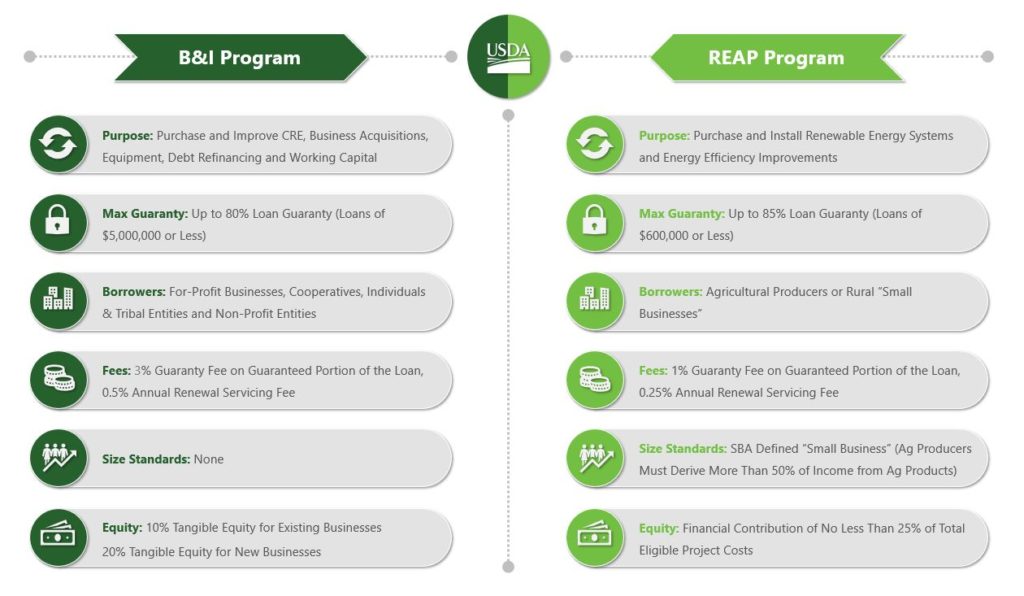
As a result of increased lending activity in recent years, small businesses in rural areas are slowly becoming more familiar with the B&I Loan Program. This program offers borrowers who operate in rural areas competitive financing packages to help support business growth that will ultimately have a positive economic impact on the local community. Some of the key benefits (unavailable through most guaranteed loan programs such as the SBA’s 7(a) Program) include the flexibility for borrowers to secure larger loan amounts, longer terms, and alternative fixed-rate options.

While you may be familiar with the B&I Program and its benefits, there are a number of reasons you might want to explore the USDA REAP Loan Program.  But first, let’s discuss its specific function and break down some of the similarities and differences to the B&I Program.

What Is A USDA Reap Loan?

USDA REAP loans are critical to increasing our country’s energy independence. It’s an area that’s both ripe with opportunity and important for our nation’s future. Funds can be used to develop power generation systems, including biomass, geothermal, hydrogen, and most commonly wind and solar generation. REAP loans can also provide funds for energy-efficient facility improvements such as lighting, HVAC, and doors or windows.

Loans approved through the REAP Program target agriculture and rural small businesses that are interested in purchasing or installing renewable energy systems or making energy efficiency improvements.

While loans through both programs must be for borrowers located in an area of 50,000 inhabitants or less and have similar maximum loan amounts (up to $25 million under certain conditions), maximum terms (up to 30 years for real estate), as well as interest rate flexibility (fixed, floating or both), there remain several key differences that should be considered.

USDA REAP Loan

You can see that there’s a great purpose for the USDA REAP loan. There are also great possibilities. Let’s look at five reasons you may want to consider a REAP loan for your business that aren’t blatantly obvious.

5 Reasons You Should Consider A USDA REAP Loan

#1 – REAP Loans Can Be Used for a Diverse Range of Renewable Energy Projects

“Utility-scale solar” is one of the most frequently discussed phrases in renewable energy. A utility-scale solar facility is one that generates solar power and feeds it into the grid, supplying a utility with energy. It’s a great combination of purpose and possibility and it’s no wonder that the REAP Program can finance projects related to this activity.  However, this is just the start. Proceeds can also support a wide variety of needs, including biodiesel and anaerobic digester facilities, as well as projects related to the generation of energy through wind, hydrogen, and the ocean.

#2 – REAP Loans Can Be Used for A Wide Variety of Energy Efficiency Improvements

According to the Center for Climate and Energy Solutions, renewable energy is the fastest-growing source of energy in the U.S., increasing 100% from 2000 to 2018.  Rapid growth in the industry requires increased amounts of capital to support purchasing, installing, or constructing brand new renewable energy systems. REAP financing not only applies to these types of new projects, but also to energy-efficient improvements, ranging from replacing energy-inefficient equipment (such as ventilation and air conditioning) to installing new lighting, solar panels, doors, or windows for a business facility.

#3 – REAP Loans Go Beyond Agricultural Businesses

Many people hear “USDA” and immediately think “Agriculture.”  After all, the four-letter acronym includes the word “Agriculture.” But don’t be fooled by the name. As long as you’re a business that operates in a rural area and meets the SBA’s definition of “small” (less than $5 million in after-tax annual income and less than $15 million in tangible net worth), you’re eligible to obtain financing through the REAP program, regardless of the type of business you operate.

#4 – REAP Loans Have Extremely Attractive Rates, Terms & Conditions

USDA loans tend to offer more flexible terms, longer amortization and provide the option of a locked rate. These advantages are limited through the SBA 7(a) Loan Program. Compared to the B&I Program, the USDA REAP loan carries a higher maximum guaranty percentage, as well as lower guaranty and annual renewal fees.

#5 – REAP Loans Don’t Need to be a Cumbersome Process

The key here is working with a bank that has time-tested and streamlined ways of doing business. When working with a lender well-versed in the USDA’s application and approval process, with a track record of success partnering with numerous USDA state offices across the country, you increase your chances of steering clear of easily avoidable headaches.  Make sure your banking partner is an industry-leading expert when it comes to understanding the nuances of this niche program.

A USDA REAP Loan can be a great resource for rural small businesses interested in installing or improving renewable energy systems. If you think a REAP loan may be a good option for your business based on its purpose and range of possibilities, make sure that you select a banking partner with a proven history of success.

Learn More About USDA REAP Loans for Renewable Energy Financing

What type of business are you?(Required)

About Capital Bank

At Capital Bank, our most important goal is to understand what’s important to you, what’s getting in your way, and what you hope to achieve, so we can help you get there. Since 1922, we’ve been creating long-lasting relationships with our customers based on old-fashioned values and future-thinking ideas.  Whether solutions come from surprisingly innovative tools or trusted products you’re familiar with, our single-focused purpose is your financial well-being.

During each of the previous three fiscal years, Capital Bank has ranked as a top 5 USDA B&I and REAP lender in the country by total dollar volume, authorizing nearly $400 million in financing collectively during this three-year period.

About the Author: Riddick Skinner is Executive Vice President of Capital Bank’s Government Guaranteed Lending division.  Providing strategic and business development oversight, Riddick is responsible for all SBA and USDA front-end loan production, including pricing, creative structuring, product diversity and strategic partnerships. Riddick’s primary niche has been within the solar electric power generation space through USDA’s Rural Energy for America Program. To learn more, email Riddick at [email protected] or call (919) 948-1986.

SBA Loan Application Tips: 4 Things to Keep in Mind

Using an SBA loan can help grow your small business but there are pros and cons. Although the SBA loan application may require time and effort, we feel the long-term advantages outweigh the cons for many small-business owners.  This is especially true for owners interested in longer repayment periods and lower interest rates.

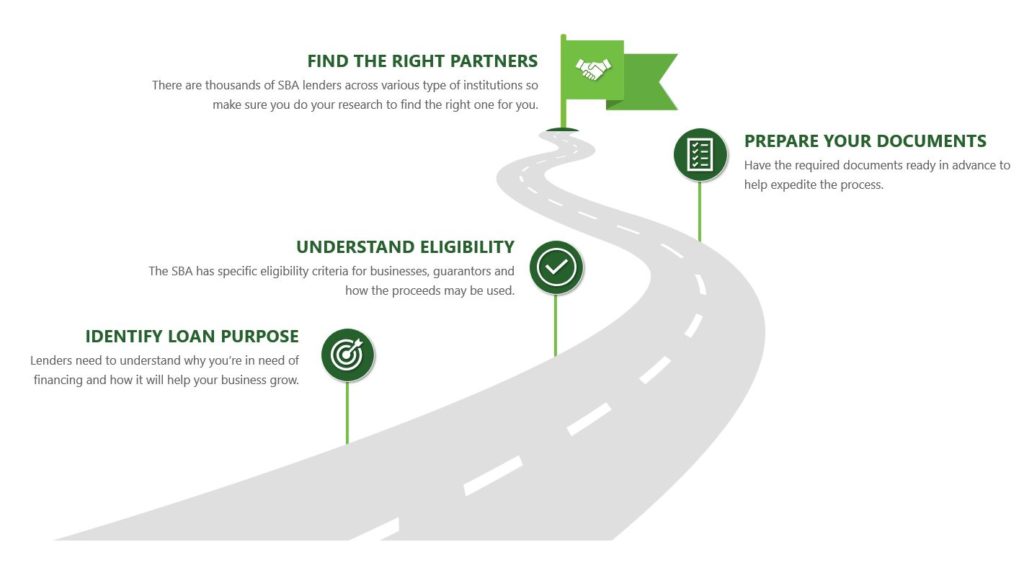
If you’ve made the decision to pursue SBA financing, the application process can seem intimidating in the beginning. However, keeping these four main areas top of mind can help you efficiently and effectively navigate the process from start to finish.
SBA Loan Application

1. Identify Loan Purpose

Be specific.  Lenders need to understand why you’re in need of financing, how much money is required and how you intend to use the funds.  You should be able to articulate how the loan will help your business, how it fits within your overall growth strategy and accurately forecast projections based on the desired loan amount.  Not only do lenders appreciate business owners who can clearly convey this information, but it will also help expedite the pre-approval and underwriting processes. 

Keep in mind some of the following examples when updating your business plan:

  • Refinance Existing Debt
  • Purchase Equipment, Inventory or Real Estate
  • Acquire a Business

You should be sure to have a detailed explanation prepared for other business expansion opportunities as well. (i.e. hiring new employees, advertising or marketing, opening new locations, etc.).

2. Understand Eligibility Requirements

The SBA has specific eligibility criteria for businesses, guarantors and uses of proceeds and an applicant should understand these criteria.  SBA 7(a) loan applications can be time consuming so it’s critical to ensure certain eligibility criteria is met prior to investing significant time and effort.  Eligibility for the SBA program can be summarized across five general categories:

  • Guarantor – Must have acceptable credit, be a U.S. citizen or legal permanent resident with no previous government loan defaults and cannot have more than $5 million in outstanding SBA loans.
  • Borrower – Businesses must be for-profit, based in the U.S., make less than $5 million in after-tax income annually and tangible net worth must be less than $15 million.
  • Industry – Ineligible industries include (but are not limited to) lenders, pyramid schemes, religious affiliations, private clubs and companies that make more than 1/3 of revenue from gambling.
  • Structure – Loans cannot exceed $5 million and terms and must be fully amortizing over a maximum term of 25 years for real estate and 10 years for all other uses.  Owners of 20% must personally guarantee the loan.
  • Use of Proceeds – Eligible financing includes working capital, business acquisitions, real estate or equipment purchases, debt refinancing or construction.

Many SBA lenders will have their own unique set of eligibility requirements over and above SBA guidance. Personal credit score, how long you’ve been in business and cash flow considerations are typically included in a lender’s determination for approval.  Many but not all SBA lenders require the following:

  • Operating business for at least 2 years
  • Minimum personal credit score of 650
  • Minimum global DSCR of 1.25x

Mitigating considerations that may allow for an SBA loan include personal liquidity and prior industry experience.

3. Prepare Your Documents

Once you’ve identified a need for capital, how that capital will be used and have determined a basic understanding of the qualification requirements, it’s time to start gathering your SBA loan application documents.  The SBA 7(a) loan application process requires specific documentation, regardless of which financial institution makes the loan.  While the entire documentation package depends on the nature of the transaction and the lender, the initial request will include:

  • Business and personal tax returns (past three years)
  • Business debt schedule
  • Business interim financial statements
  • Personal financial statement for all guarantors

This initial request will be followed by additional documentation for items including legal documentation, leases and other documents necessary to document and close the loan.

4. Find the Right Partners

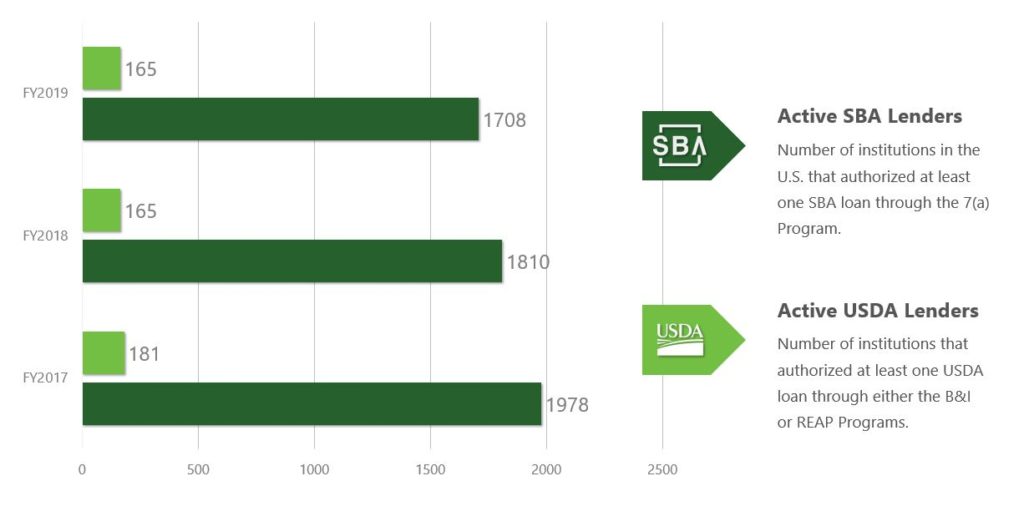
Many financial institutions offer various types of SBA loans, ranging from small community banks and credit unions to large national banks.  In FY2019, 1,708 different lenders in the U.S. approved at least one SBA 7(a) loan application.

“Preferred” SBA lenders have the capacity to expedite pre-approvals while non-delegated lenders are required to submit a complete application package to the SBA for approval. When researching partners, it’s important to consider:

  • Type of Lender – You can get small-business loans from several institution types that may specialize in certain products, including banks, credit unions, CDFI’s (Community Development Financial Institutions) and online lenders.
  • Delegated v. Non-Delegated – Experienced SBA lenders can apply for “delegated” authority which allows the institution to expedite the approval process.
  • Online SBA Loan Marketplaces – Service providers that do not fund loans but rather assist with connecting potential borrowers to experienced lenders through the utilization of streamlined processes and technology.
  • Other Resources – Your local SBA District Office and/or local SBDC (Small Business Development Center) can help provide free or low-cost consultation.

Putting together a complete SBA loan application isn’t a simple task but the benefits make the effort worth it.  The lender will want to uncover a significant amount of information about your business to determine credit worthiness.  To be successful, you must stay organized, highlight the positives about your business in the loan application and be extremely responsive when asked for additional information.  The speed of the SBA loan pre-approval and underwriting processes will ultimately depend on the information you’re able to provide.  If you’re well-prepared, you can put your best foot forward and obtain funding quickly.

Get Started: Pre-Qualify for SBA Loans at Capital Bank

Ready to get started with the SBA pre-approval process at Capital Bank? Fill out the form below to begin Step 1 of the SBA loan application process at Capital Bank. A lender will reach out to you shortly to discuss your SBA loan eligibility and your next steps for completing the SBA loan application.

SBA Loan Application at Capital Bank:

Step 1 of 8

How will you use the funds?(Required)


About Capital Bank

At Capital Bank, our most important goal is to understand what’s important to you, what’s getting in your way, and what you hope to achieve, so we can help you get there. Since 1999, we’ve been creating long-lasting relationships with our customers based on old-fashioned values and future-thinking ideas.  Whether solutions come from surprisingly innovative tools or trusted products you’re familiar with, our single-focused purpose is your financial well-being.

COVID Financial Scams Are Becoming Prevalent

COVID-19 has created opportunities for unscrupulous people to conduct scams and fraud,  and unfortunately, we’re seeing more of both.COVID financial scams are becoming increasingly sophisticated and the number of Americans being taken advantage of is on the rise.

The Internal Revenue Service is urging taxpayers to be wary of a surge of calls and emails from scammers. These scammers may emphasize words like “stimulus check” or “stimulus payment.” They may ask you to sign over your economic impact check.  They’re reaching out via email, phone, text, and social media, so please pay attention to all outlets.

Never provide your online banking credentials. No legitimate company will ever ask for this information. If you receive a call from someone claiming to be from Capital Bank, or if you get a call from anyone asking for information about your debit card, mobile banking, checking accounts or online banking credentials, hang up and call us at (866) 652-5652) immediately. We’ll help you determine if the call is legitimate. If you have any doubt or suspicion at all, hang up, delete the text, exit out of the email and reach out.

Be Alert and Take Extra Care When Opening Emails and Texts and Answering Phone Calls

At a time when it’s more important than ever to be able to trust people, it may be harder than ever to know who to trust. Before you open any email or text communications, here are some questions to ask yourself:

  • Is the sender claiming to be someone official? For example, your bank or doctor, a lawyer, or a government agency. Criminals often pretend to be important people or organizations to trick you into doing what they want.
  • Are you being told you have a limited time to respond?  Criminals often threaten you with fines or other negative consequences if you don’t act immediately.
  • Does the message make you panic, fearful, hopeful, or curious? Criminals often use threatening language, make false claims of support, or attempt to tease you into wanting to find out more.
  • Is the message offering something in short supply? Fear of missing out on a good deal or opportunity can make you respond quickly.

It’s Happening in Business Environments Too

Large numbers of people are using communications platforms like Zoom and Microsoft Teams for online meetings, providing opportunities for hackers to hijack online meetings that aren’t secured. Here are some ways to help keep your meetings safe

  • Don’t make meetings public. Instead, require a meeting password or use the waiting room feature and control the admittance of guests.
  • Don’t share a link to a meeting on an unrestricted publicly available social media post. Provide the link directly to specific people.
  • Manage screensharing options. Change screensharing to “Host Only.”
  • Ensure users are using the updated version of remote access/meeting applications.

Please be extra vigilant with your data and account information. If you have any doubts or suspicions about your security or privacy, call us at (866) 652-5652. Our family at Capital Bank hopes you and your family are staying safe and well.

Interested in an SBA Loan to Buy a Business? Here Are 6 Must-Ask Questions

You’d like to own a business but aren’t sure whether to buy one that exists or start your own.  While each path to business ownership is equipped with pros and cons, obtaining an SBA loan to buy a business has become increasingly popular for several reasons and SBA financing can be the perfect fit in many situations.

This article highlights a brief thought process you may be experiencing when evaluating whether to start your own business or buy an existing business. 

1. Why Buy An Existing Business Rather Than Start One?

Building a business from the ground up is a journey that many aspiring entrepreneurs are not prepared to face.  Steep start-up costs and unpredictable go-to-market uncertainties are just a couple of reasons. Some online sources estimate that nearly 2.5 million of the 30.2 million small businesses in the U.S. change hands in some way, shape, or form each year.  Not only does this option allow potential small-business owners to evaluate operating history and financial performance, but it also gives them the ability to bypass time spent on the administrative burdens of getting up and running, like hiring staff, implementing systems, buying licenses, and more.

SBA Loan to Buy a Business

2. Why Has Buying a Business Become Increasingly Popular?

Last year, more than 10,300 closed transactions were reported through the BizBuySell online marketplace platform, the highest annual total of small-business sales since the company started tracking data in 2007.  Strong small-business revenues, attributed to a growing economy, have sparked interest among those looking to both buy and sell small businesses.  In addition, low-interest rates have created increased buying opportunities as more and more baby boomers start to retire.  Approximately 70% of business brokers recently surveyed mentioned that nearly half of closed sales were the result of baby boomers transitioning ownership to the next wave of young entrepreneurs.

3. What Are Initial Due Diligence Steps?

If you’ve decided to begin your entrepreneurial career through the acquisition of an existing business, you may have turned to online marketplaces, such as BizBuySell.com or BizQuest.com, to research and connect with small-business owners in your market prepared to sell.  You may have even started to get the ball rolling with additional diligence, ranging from investigating credit history to engaging current employees or customers to better understand certain qualitative characteristics about the company.  But ultimately, finding the right source to finance the acquisition is where the rubber meets the road for many looking to buy a business.

4. Why Use an SBA Loan to Buy a Business?

While there are many benefits to purchasing an existing business, it can be a costly venture.  If you’re not independently wealthy or privately backed, you may need to research available financing options once the purchase price has been determined.  The most popular way to buy an existing business, including buying out a partner or opening a franchise, is through the SBA 7(a) Loan Program.  The program partially guarantees loans made by direct lenders and aims to promote economic growth by encouraging lenders to partner with small businesses that may be struggling to secure financing on reasonable terms.  Some of the best benefits include long repayment terms, single-digit interest rates, and little to no collateral requirements.  Starting an application has its complexities, so make sure to do your research on the required documentation well in advance.

5. What Are SBA Program Requirements for Buying a Business?

At a high-level, the business in question must be considered “small” by SBA standards. The business must be for-profit, based in the U.S., not engaged in prohibited activities and have owner equity invested.  In the case of brand new ownership transactions, the required equity injection must be at least 10% of the total project cost, while in partner buyout scenarios, the required equity injection must be at least 10% of the total purchase price.  Eligible options for equity injection may include cash savings, cash from personal loans, seller notes (up to half of the required equity injection amount, and must be on full standby for the life of the loan), gifts from family or friends, and certain assets and retirement plan withdrawals (taxes may need to be considered).  In addition, the SBA Franchise Directory offers a specified list of all franchises and other brands in the U.S. that are eligible to receive SBA loans.

6. What Are Next Steps?

Using an SBA loan to buy a business has gained significant traction, with some factors being a healthy economy and baby boomers reaching retirement.  Updates to the SBA 7(a) Loan Program have also helped to increase business acquisition volume authorized by financial institutions, as clarity surrounding the change of ownership rules has allowed lenders who were otherwise unfamiliar with the regulations to underwrite, process and close more transactions.  Once you have identified a business, negotiated a purchase price with the seller, and ensured certain eligibility requirements can be met, such as the required equity injection, you should connect with an SBA approved lender to proceed with the next steps.

Starting your entrepreneurial career using the SBA 7(a) Loan Program to buy an existing business involves less uncertainty and can be very rewarding if done the right way.

To see if you qualify for business acquisition financing, contact Capital Bank at (855) 693-8290 to speak with one of our experts today.


Step 1 of 8

How will you use the funds?(Required)

About Capital Bank

At Capital Bank, our most important goal is to understand what’s important to you, what’s getting in your way, and what you hope to achieve, so we can help you get there. Since 1999, we’ve been creating long-lasting relationships with our customers based on old-fashioned values and future-thinking ideas.  Whether solutions come from surprisingly innovative tools or trusted products you’re familiar with, our single-focused purpose is your financial well-being.

USDA B&I Loan Program: The Small Business Loan You Should Know About

Life is all about choices.  This may feel especially true in today’s day and age when the number of feasible options that exist – really for anything and everything – seems to be increasing. It can certainly feel overwhelming at times.  A wider and wider variety of small business loan products, programs, and lenders certainly don’t make the process of choosing an easy endeavor for small business owners in search of financing.  Certain programs or products may be fairly well-known to the general public, like the Small Business Association (SBA) 7(a) Loan Program.  However, there are also hidden gems out there with surprisingly unique advantages, such as the United States Department of Agriculture (USDA) Business & Industry (B&I) program.  If you are an eligible business, the USDA B&I loan program may just be the product to unlock benefits that you didn’t know where possible to help your company grow.

The USDA B&I Loan Program offers loan guarantees to rural businesses. These loans are made by banks and guaranteed by the USDA. Some lenders, like Capital Bank, specialize in B&I loans and can help support a wide range of rural businesses with navigating the ins and outs.

What Type of Businesses Qualify for the USDA B&I Loan?

USDA business loans help rural small businesses obtain needed credit for just about any legal business purpose. What qualifies as a “rural small business”? Businesses that operate in an area of generally 50,000 inhabitants or less. For-profit and non-profit businesses, cooperatives, and Federally recognized tribes may qualify.

How Can the B&I Loan Funds Be Used?

Borrowers are eligible to use a B&I loan to start or expand a business. Potential ways to use proceeds include working capital, commercial real estate purchases, machinery or equipment purchases, business acquisitions, and debt refinancing (when used to improve cash flow and create jobs).

How Much Can Be Borrowed?

With a USDA B&I loan, businesses may borrow a total maximum amount of up to $25 million (under certain conditions when scoring guidelines are met and approved by the USDA National Office) with a maximum Loan-To-Value (LTV) based on available collateral:

  • Max LTV for Commercial Real Estate is 80%
  • Max LTV for Equipment & Machinery is 70%
  • Max LTV for Inventory is 60%

What Are Terms for a USDA B&I Loan?

The maximum term on commercial real estate is up to 30 years.  For machinery and equipment, it’s either 15 years or for its useful life, whichever is less. For working capital, it’s up to 7 years.

Interest rates can be fixed or variable (or in some cases a combination of both) and are set by the Lender.  The percentage of the gross loan amount that the USDA will guaranty the Lender in the event the Borrower defaults is based on a range of the loan amount:

  • Loans of 0-$5 million are 80% guaranteed
  • Loans of $5-10 million are 70% guaranteed
  • Loans greater than $10 million are 60% guaranteed

There is an initial guarantee fee the USDA requires borrowers to pay, currently 3% of the guaranteed amount, as well as an annual renewal fee, currently 0.50% of the outstanding principal balance.  Reasonable and customary fees are negotiated between the Borrower and Lender.

Existing businesses must have a tangible balance sheet equity position of at least 10%.  The position jumps to 20% for new businesses or start-ups.

Why Can USDA B&I Loans Be A Great Resource?

First, let’s briefly revisit the SBA 7(a) Loan Program.  It’s very similar to the B&I Program based on how proceeds may be used and why the programs exist.  Since SBA 7(a) is more commonly used, business owners are likely more familiar with the concept.  While the two programs have overlapping features, it’s important for small business owners seeking a loan to understand the differences between the two programs and why B&I loans could be a stronger option to pursue.

Outlined below are several distinct differences and advantages offered through the USDA B&I Loan Program:

  • Location – Let’s start with a big one. A Common misconception business owners tend to have about the Program is the perception of “rural” eligibility factors.  Based on this eligibility map, you might be surprised.  While businesses anywhere can secure SBA financing, local businesses benefit through B&I.
  • Competition – There is far less competition among lenders for funding. In FY2019, there were 165 active B&I lenders that authorized at least one transaction versus 1,708 lenders that authorized at least one transaction through the SBA 7(a) Loan Program.
USDA b&I loan program
  • Loan Amount – Loans max out all the way up to $25 million with approval from the USDA National Office (avg. loan size in FY2019 was $2.0 million). SBA 7(a) loans are capped at $5 million (avg. loan size in FY2019 was $446,000).
  • Terms – B&I loan terms are longer for real estate transactions (up to 30 years) than SBA 7(a) terms (up to 25 years).
Longer maturities result in drastically lower monthly payments and conservation of cash flow, creating an opportunity to grow business operations faster.

Interest Rate – There is more flexibility surrounding interest rates. Lenders must set reasonable rates as determined by the USDA, and rates can be fixed, floating or even a combination of both (whichever makes the most sense for the Borrower).

Getting Started with a USDA B&I Loan

With a good understanding of how USDA business loans work and why they can be beneficial to rural small businesses, the next step is finding a specialty lender in the B&I space who you can trust. Out of approximately 5,000 FDIC-insured banks in the U.S., Capital Bank has ranked in the top 5 by total dollar volume authorize through the B&I and REAP USDA programs during each of the three previous fiscal years. Capital has successfully helped many rural businesses and is ready to help you.

Call Capital Bank now at 855-693-8290 to see if you qualify!


About Capital Bank

At Capital Bank, our most important goal is to understand what’s important to you, what’s getting in your way, and what you hope to achieve, so we can help you get there. Since 1922, we’ve been creating long-lasting relationships with our customers based on old-fashioned values and future-thinking ideas.  Whether solutions come from surprisingly innovative tools or trusted products you’re familiar with, our single-focused purpose is your financial well-being.

During each of the previous three fiscal years, Capital Bank has ranked as a top 5 USDA B&I and REAP lender in the country by total dollar volume, authorizing nearly $400 million in financing collectively during this period.

About the Author: Riddick Skinner is Executive Vice President of Capital Bank’s Government Guaranteed Lending division.  Providing strategic and business development oversight, Riddick is responsible for all SBA and USDA front-end loan production, including pricing, creative structuring, product diversity and strategic partnerships. Riddick’s primary niche has been within the USDA’s various lending programs. To learn more, email Riddick at [email protected] or call (919) 948-1986.

Loans for Accountants: How To Grow Your Practice

We recently explored the top-performing industries that have utilized the SBA 7(a) Loan Program to secure small-business financing. Among this group, Offices of Certified Public Accountants (NAICS Code: 541211) ranked #31, with more than 3,400 accounting firms getting help from FY2010-2019. Accountants have historically found the program to be one of the most popular ways to start or expand operations.

Although SBA 7(a) loans require the investment of time and effort, the overall benefits of the program outweigh the costs for many accountants running their own firm.  If you’re searching for a solution that will help provide the best quality services during tax season, 7(a) loans should absolutely be on your radar.  The primary benefits of the program include lower interest rates, longer repayment terms, and manageable fees in comparison to alternative commercial loan products.

Since the Great Recession, the number of businesses partnering with tax and accounting firms to track income, expenses, and taxable events has grown significantly as a result of more new businesses opening across the country.  While competition has certainly intensified with this growth, tax and accounting services remain an extremely attractive industry to lenders because these services provide necessary resources to help businesses organize their finances.

Most Common Ways Accountants Use SBA 7(a) Loan Proceeds

It’s important to make sure your firm has the bandwidth and resources to adhere to the increased volume of activity during tax season.  An external source of capital to assist with the specific needs listed below will help to ensure your business runs smoothly during tax season and beyond.

  • Human Resources – Tax season is the ideal time to hire additional employees to efficiently serve the increased number of clients. Professionally trained and knowledgeable staff is the most effective way to achieve excellent service and client satisfaction.
  • Technology – Cutting-edge software can help you manage your clients more efficiently, and security programs help ensure compliance maintenance of sensitive information. In addition, investments in your website during tax season can help maximize inbound leads and the number of appointments scheduled.
  • Expanding Services – As a professional intimately familiar with a client’s financials, stepping beyond tax preparation and bookkeeping into a consultative role has gained popularity in recent years, as it helps deepen and retain client relationships.
  • Business Acquisitions – If you own an accounting practice, you will likely sell or merge it within your lifetime. Changing demographics and the retirement of professional service firm owners create opportunities for business acquisition.
Loan Size: Similar to the average loan trends for the entire program, the average loan size for accountants has increased every year since 2010, growing at a rate of 113% during this period ($182,222 in FY2010 to $387,585 in FY2019).
Key Statistics & Trends

SBA Loans for Accountants

Before completing an SBA loan application, you should be familiar with the most popular ways accounting and tax service firms use SBA loan proceeds.  A clear and concise business plan helps increase the likelihood of lender approval.

The ability to provide above-and-beyond customer service during tax season can be difficult with so many accounting firms competing for potential clients.  Accounting professionals need to focus on operations and stress less about securing the working capital needed to execute on implementing service differentiators.  Entrepreneurs in hopes of starting an accountancy firm often overlook the need for funds to hire licensed and experienced staff, backup client accounts, store electronic documents, and expand services.

To get started with your SBA loan application, contact Capital Bank at (855) 693-8290.


About Capital Bank

At Capital Bank, our most important goal is to understand what’s important to you, what’s getting in your way, and what you hope to achieve, so we can help you get there. Since 1922, we’ve been creating long-lasting relationships with our customers based on old-fashioned values and future-thinking ideas.  Whether solutions come from surprisingly innovative tools or trusted products you’re familiar with, our single-focused purpose is your financial well-being.