You are about to leave the Capital Bank Website

DISCLAIMER: When you click Accept you will be leaving the Capital Bank (“the Bank”) website and are going to a website that is not operated by the Bank. We are not responsible for the content or availability of linked sites.

ABOUT THIRD PARTY LINKS ON OUR SITE
The Bank offers links to other third party websites that may be of interest to our website visitors. The links provided in our website are provided solely for your convenience and may assist you in locating other useful information on the Internet. When you click on these links you will leave the Bank’s website and will be redirected to another site. These sites are not under control of the Bank. The Bank is not responsible for the content of linked third party websites. We are not an agent for these third parties nor do we endorse or guarantee their products. We make no representation or warranty regarding the accuracy of the information contained in the linked sites. We suggest that you always verify the information obtained from linked website before acting upon this information. Also, please be aware that the security and privacy policies on these sites may be different than the bank’s policies, so please read third party privacy and security policies closely. If you have any questions or concerns about the products and services offered on linked third party websites, please contact the third-party directly.

SBA 7(a) Business Acquisition Loans: When and How to Use Them

The Small Business Administration’s popular loan program offers long-term capital to buy a business while preserving cash flow long term.

  • The specialized loan program lowers monthly payments by spreading out the loan over a longer term. It’s good for financing large purchases while helping business owners retain capital that can be reinvested back in the business.
  • You can use an SBA 7(a) loan to buy a business if you meet the eligibility requirements.
  • Businesses that operate with low collateral, are a newly emerging industry, and/or face other barriers to conventional financing are typically the best candidates for using an SBA loan to buy a business.

The Small Business Administration’s popular 7(a) Loan Program helps thousands of entrepreneurs secure financing every year to start, grow, or buy a business. We often point business owners to the SBA 7(a) Loan Program because it offers unique terms and benefits. When managed properly, this loan can help entrepreneurs maximize their investment back into their business during an acquisition.

Since 2020, Capital Bank has financed nearly $50 million in business acquisition loans through its government-guaranteed loan programs. Below, we’ve outlined why SBA loans are a great resource for buying a business and how our clients have leveraged them to conserve cash flow.

SBA 7(a) Loans: How It Works for Entrepreneurs

These loan programs offer extended repayment terms and competitive interest rates. They also make funding accessible to business owners who might not qualify for conventional bank financing. These unique benefits are made possible thanks to the SBA’s government guarantee of the loan.

When a loan is referred to as “government-guaranteed” it essentially means the government absorbs a large portion of the risk that lenders traditionally must take on when they offer a loan to a business.

Less risk enables your bank to offer more competitive terms even if the borrower wouldn’t traditionally qualify for them.

In this case, less risk means extended repayment terms and competitive rates. Financing with an SBA loan enables you to access these unique benefits while lending you the support of America’s Small Business Administration in addition to capital.

An important note: The loan is backed by the SBA, but it’s actually funded by a participating bank or approved SBA lender. You’ll still go through a bank to apply for your loan and will work with the lending institution to fund it.

The table below compares SBA 7(a) Loans to conventional loans. At a glance, you’ll notice the SBA 7(a) loan’s benefits typically include longer terms, smaller down payments, and more flexible ways to use the funds.
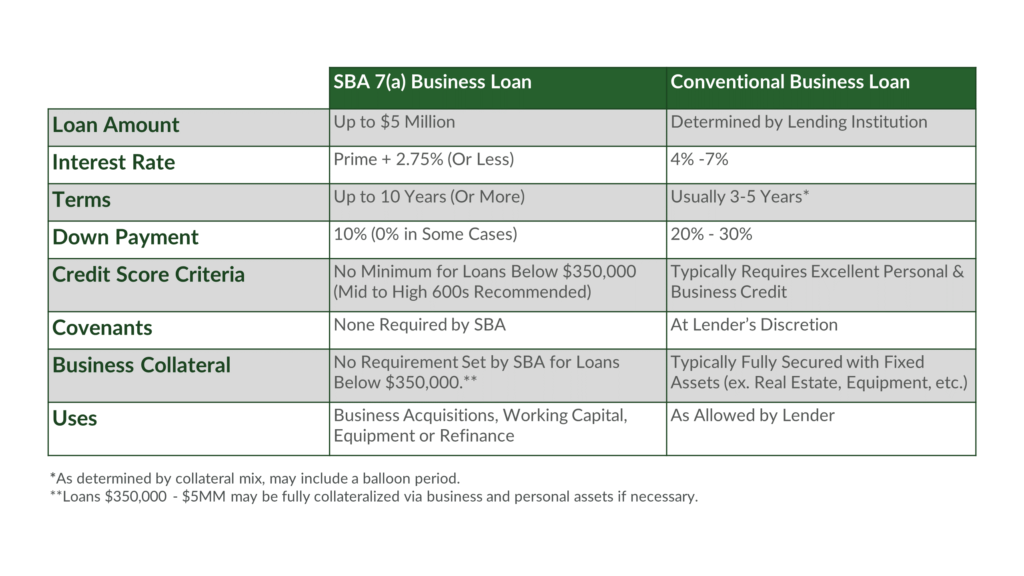
chart of estimated monthly payment sba loan vs conventional loan

Using an SBA 7(a) Loan for Business Acquisitions

Business acquisitions are one of the many eligible uses of proceeds for a 7(a) Loan.

You can use an SBA 7(a) Loan for:

  • Buying a book of business
  • Buying another practice
  • Partner buyouts

On top of financing acquisitions, you can use an SBA loan to access working capital, refinance debt, hire employees, pay for marketing costs, purchase real estate, and more. If it’s something you need to do to grow your business, you might be able to use an SBA loan to cover the costs.

The Big Idea: Protect Cash Flow While Paying Off Your Business Loan

An SBA 7(a) loan is good for buying a business because it enables eligible business owners to borrow a large sum with competitive terms and long repayment periods.

The Loan Program approves loans up to $5 million to be paid back over a standard 10-year term. A conventional loan term can typically range from 3-5 years on average.

The table below breaks down how those terms impact a business owner’s monthly payment on the loan. Let’s use a hypothetical interest rate of 7.0% for the conventional loan and 9.0% for the SBA loan (an SBA loan’s interest rate is variable but is typically calculated with WSJ Prime + 2.75%*). We’ll keep the loan amounts the same. In this case, even with the higher interest rate, the SBA loan’s 10-year term lowers the monthly payment by $2,140:
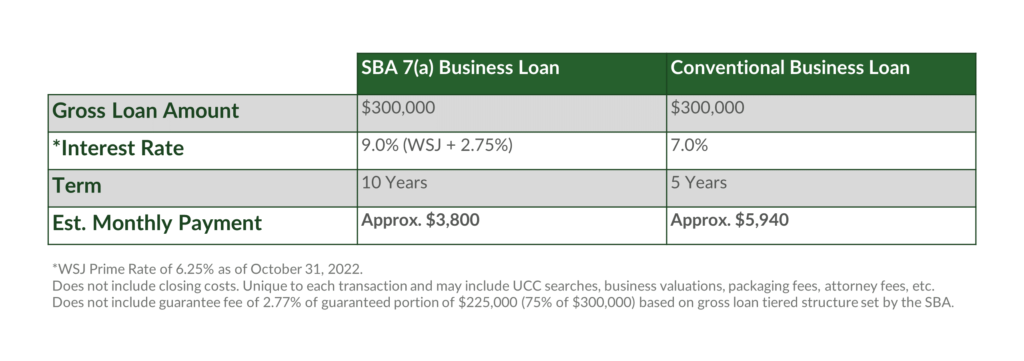
chart of estimated monthly payment sba loan vs. conventional loan

More capital stays in the business because of the extended loan repayment periods.

Additionally, the SBA loan allows business owners to fold closing costs into the loan, helping business owners retain liquidity throughout the closing process.

Both SBA loans and conventional loans will require closing cost. Closing costs may include attorney fees, the cost of business valuations, packaging fees, and UCC searches.

A conventional loan often requires the closing costs to be paid out of pocket. However, with an SBA loan, closing costs can be structured into the total loan proceeds. Meaning, less money the business owner needs to bring to the closing table.

With an SBA loan, growing companies retain some liquidity while they close and pay off their loan. The cash can then be re-invested in the business to make the most of timely opportunities.

*Interest rates are variable throughout the life of the loan and are based on WSJ Prime. Interest Rates for SBA 7(a) Loans will vary from lender to lender.

When to Use an SBA 7(a) Loan to Buy a Business

You should use an SBA loan to buy a book of business or practice when the intangible value of a business exceeds the physical collateral used to run it.

This includes industries where businesses operate with high-net-worth books of business. Financial advisors, insurance agencies, law firms, and privately owned dental or medical practices are often good candidates to use an SBA 7(a) loan for a business acquisition.

For example, let’s consider an entrepreneur who wants to buy a book of business currently priced at $350,000. A conventional loan would require a business to own fixed assets that are equal to or greater than the loan amount needed to fund the acquisition.

Meaning, your tangible assets would need to total anywhere from $350,000 – $525,000 to secure a $350,000 loan. Without expensive equipment, real estate, and assets on the balance sheet to offset the debt, you may be expected to borrow under more restrictive terms. Assuming you can secure a conventional business loan at all.

However, with an SBA loan, you can secure business-friendly terms, benefits, and competitive rates even if you can’t fully collateralize the loan with tangible assets. The SBA 7(a) loan makes it possible to invest in a new firm, practice, or book of business with a reasonable and affordable deal structure.

How to Get an SBA Loan to Buy a Business

The SBA business acquisition loan application and underwriting process at Capital Bank can be broken down into 5 phases: 

1.      Meet the Eligibility Criteria

You need to meet these four basic criteria to qualify for SBA loans:

  • Operate in the US.
  • Operate for profit.
  • Be considered a ‘Small Business’ by the SBA.
  • Credit score of at least 650 (banks may have different credit score requirements for SBA loans, but  the industry standard is usually 650 or higher. Read more about credit eligibility requirements for SBA loans.)

If you think you meet these criteria, it’s recommended that you go ahead and pre-qualify. Our Pre-Qualification Process can be completed online in minutes with this form.

2.      Speak with a Lender

One of our lenders will schedule a time to talk one on one about your business goals and growth plan. They’ll confirm your eligibility by analyzing your information and goals to determine if an SBA loan is a good fit for your next phase of growth.

If an SBA loan isn’t the right fit, your lender will share information on other financing options you might want to consider.

If you are eligible for an SBA loan and it’s a smart move for your goals, your lender will send you a list of documents to move forward with the application.

3.      Prepare Buyer and Seller Documents

To use an SBA loan to buy a business you’ll need documents that breakdown your business’s financials and your seller’s. The document checklist for SBA loans includes:

  • Business and personal tax returns (past three years)
  • Business debt schedule
  • Business interim financial statements
  • Personal financial statement for all guarantors

Keep in mind, because of this requirement you cannot complete the full SBA application unless you’ve already engaged a seller. Resume the process at Step 4 once you’ve identified the business you’d like to purchase and have secured a Letter of Intent (LOI) and/or Purchase Agreement from the Seller.

4.      Complete the Full SBA Loan Application & Underwriting Process

Use your collected documents to complete the full SBA 7(a) loan application. The application will go through an underwriting and closing process with the bank’s Lender Service Provider. You’ll work hand in hand with the team to complete every line item needed to apply for an SBA loan.

5.      Get Funded to Buy a Business

If your loan is approved, the funds will be available for your acquisition with direct support from your lending institution. Use the money to buy your business and kickstart your growth.

Buying a business is an exciting next step to your business growth. With the right financing plan, you can maximize your investment to pay off the purchase amount while keeping cash in the business. Get started funding your business acquisition:

Pre-Qualify for an SBA Business Acquisition Loan

Step 1 of 8

How will you use the funds?(Required)

About Capital Bank: A financing partner should reciprocate the level of trust you’ve built around your practice. With a 100-year+ community banking history, Capital Bank works with entrepreneurs across the US to grow their businesses with proven financial solutions.

Whether you’re interested in purchasing another book of business, facilitating growth without restricting cash flow, or getting a better interest rate on your existing loan, our team of industry experts is here to help you seize the opportunity.


         

Buying an Insurance Agency? 5 Bank-Endorsed Ways to Maximize Your Investment

These 5 Bank-Endorsed Best Practices Can Help Safeguard Your Investment in A New Book of Business.

Buying an insurance agency can be a great way to accelerate your growth. However, it’s a purchase that is inherently risky. Learn how to make the most of buying a book of business to grow your insurance agency with these bank-recommended best practices.

1.      Research Your Potential Customer

Buying an insurance agency is only worth the investment if you retain most of the new agency’s clients. Retention rates are heavily dependent on client experience, an aspect that should be a top priority during your insurance agency acquisition.

Lay the groundwork for a smooth transition by getting to know your client outside of just their demographic stats. What is the value proposition that brought them to this agency? Are there personal relationships between clients and the owner that you need to be particularly respectful of? The better you understand your clients, the better your chances of delivering a client experience that exceeds their expectations. Happy customers lead to capturing the highest potential gains from the purchase.

Additionally, research the customer base to determine how they fit into your long-term growth strategies. Do you have a highly scalable business model that is ready to roll out? You may want to buy an insurance agency book of business with a similar customer profile to your existing customer. Is your goal to diversify your agency’s customer demographics? Check that the insurance agency book you plan to buy will complement your current base. Be strategic when buying a book of business for customer acquisition to maximize your investment.

2.      Create a Communication Plan to Announce the Acquisition

The announcement of the business purchase is one of the most crucial aspects in determining the success of an acquisition. A comprehensive communication plan can help you make the all-important first impression with your new clients and colleagues.

Plan an acquisition announcement that is clear, direct, and appropriate for every party involved. The way you discuss the transition of the business with existing employees needs to be different than how you share the news with clients. The key to all your communication surrounding the acquisition is to keep it direct and frequent. Transparency throughout the process can help establish trust in new ownership, mitigate fear surrounding a transition, and improve the outlook for everyone involved.

Your communication plan may include the following pieces:

  • Internal Announcement (if applicable)
  • Email Announcement to Existing Clients
  • Email Announcement to New Clients
  • Public Announcement
  • Client Follow Up
  • Personal Client Meetings (if applicable)

With a proactive approach, your announcement plan may help you retain even more value in the book of business after the sale.  Do everything in your power to ensure the announcement is rolled out in a way that builds trust in your growing business.

3.      Understand How the Book of Business Cost was Calculated

How do you know a fair price for a book of business? An appraiser would look at key factors like earnings, profit margins, retention rates, and an industry’s economic outlook to determine how much an insurance agency for sale is worth.

Two of the big characteristics we recommend looking at to determine the cost of an insurance agency are:

  • Cash Flow and Expected Earnings

Look at the cash flow of recent years to determine what kind of revenue you’d expect this book to bring to your business. Keep in mind that spending behavior in recent years may have been volatile due to pandemic related disruptions. Yearly statements may contain outlier data that skews, positively or negatively, the revenue statements for the business. You may want to ask the seller for monthly breakdowns of profit/loss statements to annualize months with data that displays less volatility to get a better picture of typical cash flow.

  • Comparable Sales in Your Area.

Valuations often account for recent industry performance and expectations using a standard multiple. Compare the price of the agency you’re interested in with recent sales in your area, or similar locations. Does the price accurately reflect the current state of the industry?

Understanding the valuation process gives you greater insight into this company’s true value as it pertains to your business goals. Even if you work with a third-party appraiser, you should understand the factors used to determine the listing price. Ask for specific cost breakdowns when necessary to better analyze if the price is right for your investment goals.

4.      Secure Financing That Keeps Cash Flows Strong

A business acquisition can severely restrict your cash flow if you’re not prepared with the right financing options. We advise against deal structures that leave you with crippling or constricting debt. However, you may be able to secure financing that helps you fund the purchase with loan terms that still allow for your business to grow.

We often recommend SBA loans for insurance agency acquisitions because of the following terms:

  • Extended Repayment Terms

Extended repayment terms spread out payments over a longer period. This results in lower monthly payments, so there’s more cash to reinvest in the business each month while you pay off the debt.

  • Competitive Interest Rates

With interest rates in flux, the cost of borrowing runs the risk of being even more expensive. We often recommend SBA loans to eligible borrowers because the interest is based on WSJ prime, keeping payments realistic based on current economic conditions.

  • Flexible Collateral Requirements

Buying a book of business is not a purchase that includes large amounts of physical collateral. The value is mostly intangible. This can be a barrier to securing a conventional business loan since banks typically require these loans to be fully collateralized.  With SBA loans, you could still be eligible to borrow large amounts (up to $5 million) even if your business model operates without many assets.

These qualities make SBA loans highly sought after for entrepreneurs that need to finance a business acquisition while improving cash flows. Buying a book of business that you could finance with a business-friendly loan like this one can help you maximize the opportunities in the initial investment.

Buying a book of business that you could finance with a business-friendly loan can help you maximize the opportunities in the initial investment.

Check Your Eligibility

5.      Work With the Seller Throughout the Insurance Agency Transition

An involved seller transition puts the seller in a position to advocate on your behalf to their clients. It may increase the purchase price of the book of business, but seller involvement could be well worth the money spent if it means better client retention rates and an improved outlook on your management.

You’ll typically meet with the seller before the acquisition to discuss your company culture, your management style, and your philosophy on client experience. The seller probably has a clear understanding of why you’ll be a good fit for their book of business. Their clients do not.

An involved seller will help walk clients through their transition to your leadership. They’ll get the news from a trusted partner to whom they feel loyalty. The seller increases the value of their book of business by improving retention rates. And you, the buyer, maximize the potential return on your investment.

Buying an insurance agency can be a great way to grow your agency quickly and efficiently if you’re making the most of the investment. These best practices should set you on the path to buying a book that’s worth the return on investment.

Pre-Qualify for an SBA Loan for Business Acquisitions in Just Minutes:

Step 1 of 7

How will you use the funds?(Required)

About Capital Bank: A financing partner should reciprocate the level of trust you’ve built around your practice. With a 100-year+ community banking history, Capital Bank works with entrepreneurs across the US to grow their businesses with proven financial solutions.

Buying a Book of Business: 5 Questions Financial Advisors Should Ask

Buying a book of business to grow your existing practice is a big leap for your financial practice. It’s not just a way to scale. When you buy a book of business from another financial advisor you purchase their customers’ dedication, trust, and loyalty. It puts you in a unique position to balance your practice’s growth while catering to an entirely new set of customers’ unique financial needs. But an acquisition also comes with financial and intangible risks to your existing practice.

The right business acquisition will put your financial practice in a position to onboard new clients efficiently and effectively. But how do you know if you should buy a book of business: is it the right fit for your customer management style? Will the clients want to stay with your practice? Is your practice ready to intake customers? Are you paying the right price for the book?

Ask yourself these 5 questions before you buy a financial advisor book of business to grow your practice.

1.      Is There Client Synergy?

Buying a book of business from another financial advisor is only a successful growth tactic if you can successfully retain customers after the merger. Synergy between your book of business and a new book could help reduce the risk of customer defection. Clients from the book you’re buying will be more likely to understand your value, processes, and business model if there’s synergy between the practices. Synergy indicates a higher likelihood that they’ll stay.

This is especially true for advisors that specialize in the growing sector of ESG and/or impact investing. Clients of these practices often select a mission-driven financial practice that shares their philosophies and values. If your practice doesn’t align, retaining new clients may be an uphill battle.

Synergy should also be discussed in the context of account management between the books. Examine the processes used to manage both financial practice books of business. How does your client management align with the financial practice you’re purchasing?

Consider a loyal client from the new book that’s been with their advisor for the last 15 years. They may be accustomed to a certain level of communication, service, and client-facing interaction. If you can’t offer that at this time, you jeopardize their loyalty and trust in you, their new advisor. It may be more difficult to retain them if you need to introduce a new style of communication, investment management, and service.

Ask yourself if your processes could be extended to new customers as they currently exist. If you would you need to make substantial investments to change your processes for onboarding and managing the new book of business, consider purchasing a more closely aligned practice.

2.      How Was the Book of Business Valuation Calculated?

When deciding how much a book of business is worth, appraisers often calculate a purchase price using a standard multiple for the yearly revenue of the book. However, current valuations rely on data from the most recent years. And our most recent years are not necessarily indicators of long-term performance because of outlier behavior and data.

Decide how much you should pay for a book of business based on the most accurate projections available. Try to obtain monthly breakdowns for years that exhibited ‘outlier’ behaviors like those induced by the pandemic. Annualize ‘normal’ months instead of taking yearly data at face value to get a more accurate idea of how much a book of business is worth in 2022, onward. This method should help you gauge long-term revenue potential over stabler conditions.

Certain intangible qualities of the book, like client goodwill, are also harder to value. When determining how much you should pay for the book of business based on goodwill, you may want to consider turn over rates, client retention rates, and cross-sell rates (how often did a customer elect for additional services after their base service). These are all statistics that indicate the book of business is full of ideal customers with healthy spending behavior for your practice.

If the numbers are healthy, it should be reflected in the business valuation. Be wary of valuations that inflate the value of client loyalty if these key performance indicators say otherwise.

3.      Will the Seller Help Transition the Book of Business to Your Financial Practice?

Seller involvement can be a crucial element of client retention during a transition of business ownership. A seller that stays involved after the purchase bolsters the chances that the book retains its purchase price value.

An involved seller will help walk clients through their transition to your leadership. They’ll get the news from a trusted partner to whom they feel loyalty. The seller increases the value of their book of business by improving retention rates. And you, the buyer, maximize the potential return on your investment.

You should account for the benefits of a highly involved seller when determining how much you are willing to pay for a book of business. Though the purchase price will be higher, you may have a much better chance of a higher return on investment than if the seller walked away as soon as you sign the dotted line.

Before you buy a book of business be sure to inquire about the level to which the seller is willing to advocate for your leadership to their roster of clients.

4.      Are You Using the Business Acquisition to Pivot Your Revenue Model?

Some advisors transition their business from a commission-based model to a fee-based practice by buying a new book of business from an existing fee-based advisor. This type of acquisition accelerates your jump into fee-based planning as opposed to gradually transitioning an existing book over a long period of time. However, if you’re planning to buy a book to accelerate a transition to fee-based planning make sure you lay the groundwork first.

There are a couple of things you’ll need to do in your own practice to prepare for a transition that pivots your business model. The most important, if not the most obvious: make sure you’re registered as a fee-based advisor in time to onboard the new accounts. The book is only valuable to you if it’s a client base you’re allowed to service. Perform your due diligence to make sure you’re acting compliantly based on what you’re legally allowed to offer.

Secondly, prepare your existing audience for the change in their services. Before making the announcement, tailor communications to explain what their new fee structure will cost, why it’s better for their account management, and what they can expect from you moving forward. Communicate clearly and often to help both your existing client base and your new book of business feel confident in your value as their new advisor.

5.      Do You Need to Finance Buying a Book of Business?

You may need to finance your acquisition of the practice, depending on how much the book of business costs. If the sale of the book of business is time sensitive, make sure you come prepared with financing options that you can move quickly on. Putting a financing plan in place before the negotiations start helps you become a more competitive buyer that can strike while the iron is hot.

Putting a financing plan in place before negotiations start makes you a more competitive buyer who can strike while the iron is hot.

Check Your Eligibility

Not all business acquisition loans are alike. We recommend looking for a loan that offers long-term, patient capital.

Our recommendation for buying a book of business is often the SBA 7(a) loan. This loan program can be great for acquisitions because of its 10-year repayment term (30 years if real estate is involved), fully amortizing terms, and competitive interest rates. Financial advisors are especially a good fit because of the flexible collateral requirements of the 7(a) Loan Program. Though valuable, a book of business is priced for its intangible worth. It’s not something a bank can collateralize. The SBA loan makes it possible to secure competitive financing for the purchase even if other comparable business loans are off the table.

However, you’ll want to prepare for financing in advance if you plan to utilize the 7(a) program most efficiently. The SBA 7(a) loan application is detailed and document-heavy. You’ll need to approach the table ready to move quickly with your lender if want to use an SBA loan to buy a book of business.

Pre-Qualify for a business acquisition loan from Capital Bank online to get ahead of the process. Our Director of Financial Advisory Lending will reach out to discuss your business goals and loan options in more detail to give you a jump start on the financing process.

Pre-Qualify for an SBA Loan for Business Acquisitions in Just Minutes:

Step 1 of 7

How will you use the funds?(Required)

About Capital Bank: A financing partner should reciprocate the level of trust you’ve built around your practice. With a 100-year+ community banking history, Capital Bank works with entrepreneurs across the US to grow their businesses with proven financial solutions.

USDA Farm Loans: 3 Things You Must Know When Getting Started

Access to capital can be a “make-or-break” issue for farmers or aspiring producers who need financial support to launch their agriculture operation.  That’s why the United States Department of Agriculture (USDA) Farm Service Agency (FSA) offers a wide variety of lending programs for beginner or experienced farmers to start, improve, expand, or transition family farming and ranch operations.  However, when starting the initial search for USDA farm loans, it can be difficult for farmers to get a quick snapshot of how to best leverage Agency resources based on their unique financing needs.  In this article, we’ll breakdown three areas of the FSA lending process to help farmers navigate where to start when exploring USDA farm loans.

1. The Difference Between Direct and Guaranteed USDA Farm Loans

The FSA administers both direct and guaranteed financing through many of the same programs it offers (although guaranteed loans are equipped with higher maximum loan amounts than direct loans).  Farmers apply for direct loans through a local FSA county office whereas guaranteed loans are made by a financial institution, and the FSA guarantees up to 95% of the loan, protecting the lender against the possible loss of principal and interest.

  • Direct Loans: These loans are for farmers who have limited financial history to qualify for commercial credit or who have experienced financial setbacks as a result of a natural disaster.  The money used to fund these loans comes from Congressional appropriations received as part of the USDA’s annual budget.  Farmers must apply for direct loan assistance in-person at an FSA county office or through a local USDA Service Center.  A loan officer with the FSA will meet with the applicant to assess all aspects of their financial situation, including whether or not eligibility requirements will be an issue.  Approved borrowers who choose to receive a direct loan from the FSA are required to attend borrower training, which typically consists of a classroom type workshop on financial management.
  • Guaranteed Loans: These loans are for farmers who may not be able to obtain a conventional loan from a commercial lender.  Farmers apply for guaranteed loans as they normally would with any commercial lender.  The commercial lender must be USDA-approved to participate in the FSA guaranteed programs.  The lender will first analyze the business plan and financial condition of the operation.  If the farm loan proposal looks realistic and there is sufficient collateral, but it cannot be approved because it does not meet the lending institution’s typical underwriting standards, the lender may apply for an FSA loan guarantee directly with the Agency.  If approved, the FSA provides oversight of lenders’ ongoing loan servicing activities and in the event the lender suffers a loss, the FSA will reimburse the lender according to the terms and conditions of the specific guarantee.
Often times, farmers may go the route of starting out with a direct loan application, but the Agency will want to see that a guaranteed loan was first considered.

The FSA ultimately seeks to help farmers graduate to being able to obtain credit from a commercial lender.  Once they are able to do so, their “mission of providing temporary, supervised credit is complete.”  If qualifications for a guaranteed loan from a lender are not met, a direct loan can be provided by FSA assuming the applicant is a beginning farmer or has not had a prior direct loan outstanding for more than the term limits of the loan.  In addition, the applicant must be able to demonstrate sufficient education, training, and experience in managing or operating a farm.

2. The Different Types of Guaranteed FSA Loans

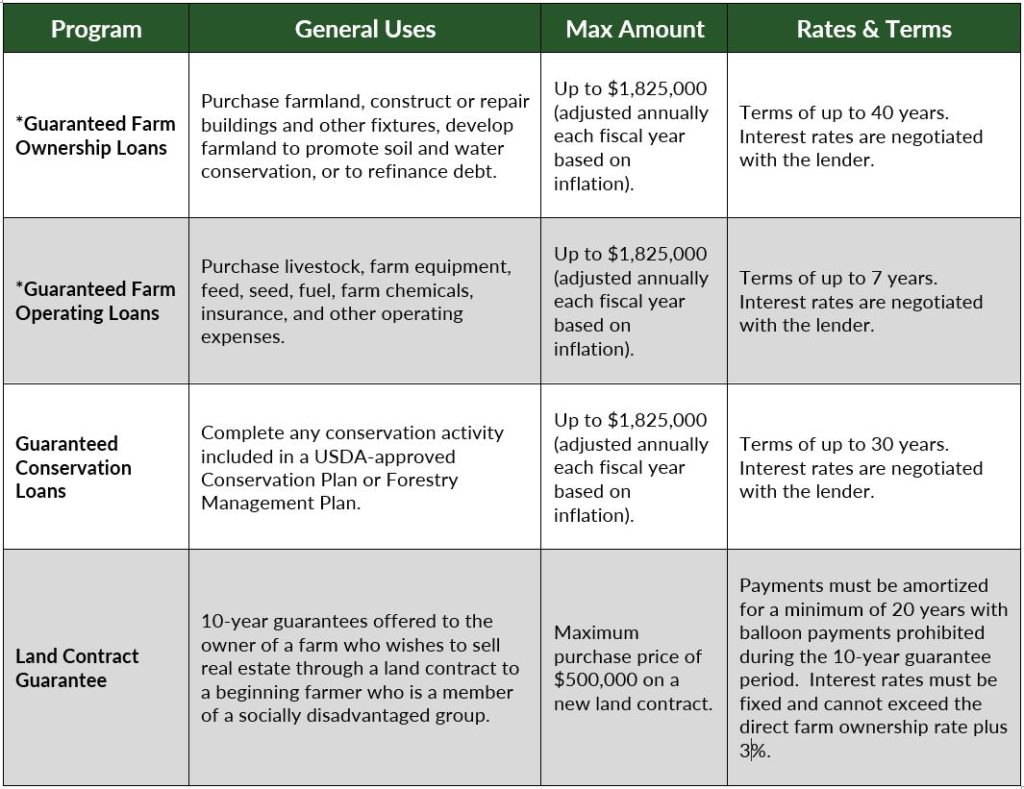
Since the first step involves researching guaranteed FSA loan program options, the remainder of this article will focus only on those programs available through the Agency that are made by commercial lenders.  Although there are four programs available for guaranteed financing, Guaranteed Farm Ownership and Guaranteed Farm Operating loans are by far the most commonly utilized by borrowers.  The below chart provides a brief summary of the uses, maximum amounts and terms available through each guaranteed program.

USDA farm loans table

*Streamlined financial underwriting is available through an EZ Guarantee for loan applications up to $100,000 for Guaranteed Farm Ownership Loans and Guaranteed Farm Operating Loans.  All existing eligibility, loan purpose, security, and other requirements remain the same.

It’s important to keep in mind that direct financing may also be available through one or more of the four programs outlined above but the loan amounts and terms will differ.  When looking at the different guaranteed loan programs, financing needs should align with the appropriate loan type based on criteria of the program.

3. The Eligibility Requirements for FSA Guaranteed Loans

Depending on the type of loan, prospective borrowers will have to meet certain eligibility requirements set forth by the USDA.  Additionally, each participating lender is permitted to have its own set of program eligibility requirements for guaranteed USDA farm loans.  Below are examples of general eligibility requirements for Guaranteed Farm Ownership Loans, Guaranteed Farm Operating Loans and Guaranteed Conservation Loans.  However, Conservation Loan applicants do not have to meet the “family farm” definition, nor do they have to be unable to obtain a loan without an FSA guarantee.  For more information on Land Contract Guarantee eligibility requirements which are not included below, click here.

  • Applicants must be a citizen of the U.S. (or legal resident alien), which includes Puerto Rico, the U.S. Virgin Islands, Guam, American Samoa, and certain former Pacific Trust Territories.
  • Applicants must have an acceptable credit history as determined by the lender.
  • Applicants must have the legal capacity to incur responsibility for the loan obligation.
  • Applicants must be unable to obtain a loan without an FSA guarantee.
  • Applicants must not be delinquent on any Federal debt.
  • Applicants must not have caused FSA a financial loss by receiving debt forgiveness on more than three occasions on or prior to April 4, 1996, or any one occasion after April 4, 1996, on either an FSA direct or guarantee loan.
  • Applicants must be the owner-operator or tenant-operator of a “family farm” after the loan is closed. For an Operating loan, the producer must be the operator of a family farm after the loan is closed.  For a Farm Ownership loan, the producer also needs to own the farm.

If you are thinking about borrowing money to start or expand your farm business, it’s important to know your options before starting the application process.  Experienced FSA lenders like Capital Bank, and insurance providers like Capital Insurance Agency, can help make financial recommendations more efficiently when prospective borrowers are prepared to share their program(s) of interest.

Our team of FSA lending experts is ready to talk!

Apply for a USDA FSA Guaranteed Loan

Submit a Franchise to the SBA Directory: Step by Step Guide

Franchises must be listed on the SBA Franchise Directory to be eligible for an SBA franchise loan. Here’s how to submit yours for consideration.

Plan on buying a franchise using an SBA loan? You’ll first need to make sure the business is listed on the SBA Franchise Directory. The SBA requires franchises to be included on this list of businesses in order to be eligible for their entrepreneur-friendly loan programs.

Understanding SBA Franchise Directory Requirements for SBA Franchise Loans

Many new owners choose to buy a franchise with SBA loans because of the unique loan benefits. SBA franchise financing opens the door to affordable capital with longer terms and flexibility in how the funds can be used.

However, not every franchise makes the cut for the small business loan programs.

The SBA wants to support businesses that put revenue back in local entrepreneurs’ hands. Franchises may seem like an unusual candidate for their loan programs, but they may still be eligible.

The SBA assesses a business’s loan eligibility based on how much autonomy they give the franchisee.  Franchise agreements must let the franchisee operate as independent business owners within the framework of the franchise rules to qualify for SBA franchise loans.

If they’re deemed eligible, the franchise is added to the official SBA Franchise Directory. Entrepreneurs who own a franchise on the Directory can then apply for financing through SBA loan programs.

Step 1: Check to see if the franchise is already listed.

Before submitting a franchise, check to make sure it hasn’t already been approved by the Small Business Administration. If your franchise name is on this list, it is eligible for SBA financing. The Directory will also list if the franchise will require additional documentation or limitations on SBA loan options based on the agreement type.

You can check the SBA Franchise Directory Here. Simply search the franchise name that you’re interested in financing with SBA loans. If it’s on the list, it’s eligible. You can skip the following steps and proceed with your SBA franchise financing application.

Step 2: Gather the required documents.

The SBA lists out a few sets of documents they need to determine a franchise’s financing eligibility:

  • Completed copies of the franchise/license/dealer/jobber or similar agreement for the brand
  • The Franchise Disclosure Document
  • Any other documents that the SBA would need to sign for the franchise

Existing franchise owners that need an SBA loan for working capital or specific project uses probably already have access to these documents. If you are buying a franchise, work with the seller and the franchise to find these documents.

Step 3: Send your franchise to the SBA.

Once you’ve gathered your documents, it’s time to send them to the SBA for review. Email the documents to [email protected] with your request for inclusion in the Directory.

If you want to get ahead with the remainder of your application while their decision is pending, continue assembling the remainder of your application. You can learn all about the process for securing an SBA loan to buy a franchise with our online Franchise Financing Guide.

Step 4: Receive SBA Franchise Directory decision.

The Directory is updated weekly by the SBA, but it can take up to three months to process any franchise submissions. Potential franchisees are welcome to submit at any time, but keep the SBA’s time frame in mind. Prioritize submitting to the Directory early on if your SBA loan is time sensitive.

Step 5: Apply for SBA franchise financing.

A franchise that’s listed in the Directory is eligible for financing, fully or provisionally. Occasionally, certain franchise agreements will require additional documentation to secure an SBA loan. The SBA will include any of these stipulations in the Directory.  Work with your lender to understand any additional provisions your franchise needs to meet.

Once your franchise is on the Directory, you’re free to move forward with your SBA loan. Get started with your SBA franchise loan here.

Why Use SBA Franchise Loans for Franchise Financing

Franchises can be expensive from the onset. Buying a franchise typically requires a franchise fee, the purchase or lease of property, inventory or equipment purchases, staffing expenses, and marketing costs. Once you own the franchise, royalty fees and miscellaneous expenses kick in.

An SBA loan gives entrepreneurs a few key advantages:

  • The flexibility to use loan proceeds the way they need to. SBA loans remove some of the limits on eligible uses of the loans to help support more entrepreneurs’ diverse needs.
  • Longer annuities. SBA loans typically come with 10 or 25 year terms, longer than most conventional loans. Longer terms spread out payments, so entrepreneurs may operate with greater cash flows month to month.
  • Interest rates set by the SBA. The Small Business Administration sets a baseline interest rate for SBA loan programs to keep the loans competitive in the current economic climate.

Have questions about your eligibilty for SBA franchise financing your franchise? Submit the form below to speak with a lender about your options for franchise financing.

Check Your SBA Franchise Loan Eligibility:

"*" indicates required fields

How will you use the funds?*

5 Documents Needed to Finance a FedEx Route

Prepare these documents to get ready for your FedEx SBA loan application.

Using SBA loans to buy a FedEx Route could be a good option for entrepreneurs who want longer-term, business-friendly loans to finance their purchase.

SBA loans typically have less strict collateral requirements than conventional business loans. They can be a good fit for the FedEx route business model since route ownership is not a business that requires an excessive amount of assets that can be counted as collateral.

FedEx route owners also tend to appreciate that the longer terms of SBA loans result in smaller monthly payments. That’s more capital to invest in the business month to month, without paying a premium on your interest rate.

One drawback of SBA loans is that they do require more paperwork than conventional loans and a longer timeline for funding. It’s a trade-off for securing a government-guaranteed loan’s great benefits.

Starting your documentation collection early can help expedite the process and keep it manageable.

Focus on preparing these 5 documents to get ready for an efficient loan application.

1.      Business Plan with Resume

Your Business Plan is one of the first documents a lender will look at when determining your loan eligibility. If you want to make the best first impression and help organize yourself for success throughout the application process, make sure your Business Plan is top-notch by using our business plan resources in this article.  

Get started by downloading our free business plan template for SBA loan applications. Tailor it to address a few key details lenders need to see to determine your SBA loan eligibility.

First, address your transition plan for the business. Buying a FedEx route is viewed as a business acquisition. You’ll need to provide details about the transition of ownership to help your lender understand how you plan to manage the route once it’s yours. Identify the exact route you wish to purchase in your business plan, if possible.

SBA loan applications also require you to detail your management experience in your Business Plan. The SBA loan program is not intended to support businesses that are passively managed, so lenders will want to see applicable operational and managerial experience from prospective borrowers.

Include any management experience you or your team members have in this industry, or others. You can include experience in logistics, staffing and recruitment, management of teams or finances, etc.

The official Request For Information (RFI) you’re required to send to FedEx will include a lot of the information you’ll need to add to your FedEx route business plan for an SBA loan application. Keep it on hand to help you write your Business Plan.

2.    Financial Projections for the FedEx Route with Written Assumptions

Lenders want to see how the business will grow under the new ownership. The Financial Projections are a prediction of how much money you’ll bring in each month, how much you’ll spend each month, and the profit you turn based on both factors.

You’ll need three (3) years of financial projections. Break down your first year of the business month by month. The other two years can be annualized projections. All 3 years will need to have written assumptions discussing future revenues and expenses you provide in the projections.

Lenders will look for these explanations of your calculations written out as ‘assumptions’. This part is particularly important for SBA loan applications. You’ll need to explain how you’re determining hypothetical numbers to use in calculations so that your SBA lender can help make sure the projections are reasonable.

3.       Business Tax Returns (for both the Buyer and the Seller)

You should prepare to submit 3 prior years of Business Tax Returns for both yourself and the person selling their FedEx Route(s).

Business Tax Returns are required by the SBA. Any lender that you would use to finance buying a FedEx Route should ask for a copy of 3 years, including all schedules. If you don’t already have them on hand, you’ll want to collect them when you prepare to buy a FedEx route.

Be sure to collect 3 years of returns from the seller and have 3 years of personal returns ready to provide to your lender. If you own existing businesses, you’ll need to provide 3 years of tax returns for those entities as well. Year-end financial statements will not suffice as most lenders underwrite to the tax returns.

4.      Interim Business Financial Statements

To assess the current operations of the selling entity, your lender will ask for Interim Business Financial Statements from the seller, in addition to the tax returns.

Interim Business Financial Statements consist of the year-to-date profit and loss statement, balance sheet, and debt schedule (it is important to understand if any of the vehicles have outstanding debts). They’re used to help gauge the most up-to-date performance of the FedEx route business throughout the current year.

Work with the seller of the FedEx route to assemble the interim business financial statements. You’ll need to include an income statement, balance sheet, and debt schedule for the year to date.  

5.      Personal Financial Statements

Prepare your own personal financial statement. This should include your assets, debts, and income outside of the FedEx business.

The personal financial statement helps your lender understand your financial strength and which financing options are available. This is an especially important document for business acquisitions and startup businesses since the overall strength of the owner is a larger part of the credit analysis, compared to analyzing an existing business with a demonstrated track record.

Other Documents You’ll Need to Finance a FedEx Route with SBA Loans:

Affiliate Financials

The SBA requires statements for all the businesses in which you own 50% or more. You will be required to provide the affiliate financials for these businesses, which includes the business returns, financial statements, and debt schedules for those businesses in addition to the statements for the FedEx route acquisition.

Part of the SBA loan eligibility criteria is a ‘credit elsewhere’ test. By requiring the financials for all your affiliated businesses, the SBA can assess your ability to secure financing through a conventional loan option. This helps them determine whether or not their small business loan is a good fit for you based on your business portfolio.

Streamline your SBA loan application by compiling your affiliate financials alongside your other financial statements.

Letter of Intent or Draft Purchase Agreement (with Exhibits)

If you plan to utilize seller financing to purchase a FedEx route, provide your lender with a Letter of Intent (LOI) or a draft Purchase Agreement (PSA) with exhibits between you and the seller of the route.

Seller financing is a financing option in which the seller works with your lender to finance part of the down payment for the FedEx route purchase. The seller absorbs some of the risks of the sale, so they’re incentivized to see you succeed because their money is on the line, too. As a buyer, seller financing should signal confidence in the route from someone that’s worked it before.

You don’t need seller financing to secure an SBA loan to buy a FedEx route. However, seller notes either on full standby or normal repayment terms are often favorably viewed by lender’s credit teams.

An LOI or PSA are both great documents to give your potential lender to keep the financing process efficient. Both documents provide many of the details your lender will need to structure your financing package. By submitting one of these documents with your application, you’ll provide a a quick reference on the purchase terms, non-solicit/non-compete, seller and buyer’s disclosures, details on any seller note(s), and any contingent items.  

Get Ready to Buy a FedEx Route with Affordable Financing

Whether you’re still researching FedEx routes for sale or getting ready to apply for an SBA loan, we hope to be your financing resource throughout the entire process. Check your eligibility for FedEx route financing options by completing the form below:

Step 1 of 7

How will you use the funds?(Required)

Capital Bank is not endorsed by and is not recommended by Federal Express Corporation and FedEx Ground. Capital Bank is not sponsored by, is not approved by, is not associated with, and has no connection with Federal Express Corporation or FedEx Ground.

10 Top Industries for SBA 7(a) Loans in 2022

These industries show promise for growth and success with SBA 7(a) loans according to recent 2022 data.

SBA loans were made to help small business owners succeed in competitive economies. These attractive loans come with competitive rates, longer terms, and flexible use of proceeds. Entrepreneurs typically like that they can access long-term ‘patient’ capital that can be used in many ways across so many different industries.

Only a few industries are ineligible for SBA Loans. Eligibility is based on the way the individual business is structured and operated rather than its industry.

However, there are some industries where it’s more popular to finance with SBA loans than others. A few industries show particularly strong outlooks for securing SBA loans based on this year’s lending trends.

Below, we’ve listed out the top 10 industries for SBA loans based on nationwide approved loan volumes for fiscal year Q1 and Q2 numbers from 2022.

Why do Top Industries for SBA 7(a) Loans Matter?

It’s easier to get funding when there is demonstrated success in your field for SBA loans. Previous loans approved for the industry set the precedent for your business to secure funding if you’re in the same industry with similar outlooks.  

When the SBA reviews your application, they’ll see if you’re in an industry that they’ve awarded funding before. If you fall into one of the top industries for SBA loans, you’re that much more likely to be approved for small business financing.

An increasing percentage of approved SBA loans in your industry also indicates upcoming growth in your industry. If loans are going to support the growth of car washes, for example, you can predict that there will be the funding needed to introduce more innovation, ramp up demand, and increase the potential for continued success in your field.

A rising tide lifts all boats. Financing that’s gone to other businesses in your industry can help you secure your own SBA loan and grow with confidence.

The 10 Top Industries for SBA Loans in Ascending Order Are…

#10 SBA Loans for Offices of Physicians (Except Mental Health Specialists)

$153,889,200 in SBA loans were approved for Offices of Physicians in the first half of 2022.

Doctors’ offices and private practices come in at number 10 for SBA financing across the nation. Doctors can use SBA loans to grow their businesses in many ways. We often see doctors using SBA loans to buy out their practice from a retiring partner, invest in new technology or equipment, enhance patient experience and care, and recruit new employees with more competitive wages.

Physicians may also use SBA 7(a) loans to finance marketing and advertising initiatives to help their private practice compete with larger healthcare networks. The affordable, long-term, patient capital made possible through SBA loan programs could be your practice’s big advantage over big healthcare.

#9 SBA Loans for Fitness and Recreational Sports Centers

$156,875,400 in SBA loans were approved for Fitness and Recreational Sports Centers in the first half of 2022.

Recreational sports centers and fitness centers could be good candidates for SBA loans in 2022. Based on SBA loan data from the first half of the 2022 fiscal year, these businesses are in 9th place for small business financing.

Fitness and Recreational Sports Centers may include independent facilities or chain fitness studios. A select list of fitness franchises are eligible for SBA loans. You can search for your fitness franchise on the SBA Franchise Directory to see if you qualify.  

Independent gyms, boutique fitness studios, and sports clubs can utilize SBA 7(a) loans and SBA Small Loans (less than $350,000) to help finance buying gym equipment and renovating a property to be usable for their business. Need to turn that extra room into a yoga studio? Or maybe you want to replace your weight room equipment, or hire new instructors? SBA loans can help.

#8 SBA Loans for Offices of Dentists

$169,283,500 in SBA loans were approved for Offices of Dentists in the first half of 2022.

Dentists can use SBA loans to buy out their partner at their dental practice or invest in the growth of the dental practice.

SBA loans for dental practices can be used to hire and train staff, install additional chairs, update equipment, renovate office space and waiting rooms, finance the merger of two practices, partner buyouts, market a practice to increase new patient intake, and access working capital.

As an SBA specialized lender, we have worked with many dental practices to finance their growth and increase their capacity to accept new patients. Learn more about securing an SBA loan for your dental practice with our specialized team at Capital Bank.

#7 SBA Loans for Specialty Trade Contractors

$172,222,400 in SBA loans were approved for Specialty Trade Contractors in the first half of 2022.

This category encompasses many different business types. Usually, these specialty trade contractors work with general contractors. Plumbers, electricians, site preparation, concrete pourers, and other contractors are all included in this industry for the purposes of securing SBA loans.

Specialty Contractors can leverage the SBA loan programs’ flexible use of proceeds to ramp up their business during busy seasons. Contractors often need more expensive equipment than most businesses to even get started. Heavy equipment and machinery also come with maintenance and repair costs. SBA loans can be used to finance such purchases and their ongoing expense.

Additionally, trade contractors can use SBA financing to access working capital to help their business stay steady in the off-season. Their versatility makes SBA loans appealing to specialty trade contractors, who have leveraged them successfully enough to break the industry into the top 10.

#6 SBA Loans for Car Washes

$177,756,500 in SBA loans were approved for Car Washes in the first half of 2022.

Car washes are on the up and up for SBA loans. Last year, the industry was estimated to be worth $14.7 billion. In the first half of this year alone, over $177 million was approved in SBA financing for car washes, making them the 6th top industry for SBA loans.

As a dedicated SBA lender in the car wash space, it comes as no surprise that this industry is excelling in getting approved for small business loans. SBA loans are good for car washes because they can be used to acquire a car wash, renovate a car wash, modernize a car wash, and much more.

Additionally, there’s a list of approved car wash franchises that are approved for car wash financing with SBA loans. Read more about using SBA loans for car washes and access the list of car wash franchises eligible for SBA loans on our blog.

#5 SBA Loans for Gas Stations with Convenience Stores

$211,612,800 in SBA loans were approved for Gas Stations with Convenience Stores in the first half of 2022.

Gas Stations with Convenience stores kick off the top five industries for SBA loans, with more than $200 MILLION in approved financing during the first half of the 2022 fiscal year.

SBA loans could help gas station owners access financing with reasonable terms. The funds can be used to buy a gas station, open a new location, purchase inventory, hire new employees, fix broken pumps, install new pumps, and purchase advertising slots.

Additionally, working capital can help gas station owners maintain their books even when the costs of goods fluctuate.

Today’s gas station owners are faced with the immense challenge of turning a profit even as oil and gas prices fluctuate. When the cost of oil rises, access to affordable working capital becomes even more important for gas station owners who need to grow their businesses despite economic conditions.

#4 SBA Loans for Child Day Care Services

$225,305,100 in SBA loans were approved for Child Day Care Services in the first half of 2022.

Access to childcare and day care is a top priority for working parents across the country. The increased popularity of fully remote and hybrid work schedules continues to keep demand high for childcare services. But day care centers face challenges of their own.

Staffing and capacity are two major concerns for childcare centers already in operation. Without the proper resources to safely serve more families, daycare centers are taxed to the limits and forced to turn away business.

SBA loans can help existing childcare centers increase their capacity to meet existing and future demand. Financing for daycare centers through the SBA is also eligible to be used to buy a day care or childcare center.

The high volume of approved SBA loans for child daycare centers this year is promising for both families and the businesses who serve them.

#3 SBA Loans for Limited-Service Restaurants

$341,848,600 in SBA loans were approved for Limited-Service Restaurants in the first half of 2022.

Limited-Service Restaurants include businesses that serve food either in a limited capacity or at limited times. Oftentimes these restaurants are ones where customers pay before they eat, as opposed to getting the check after.

Limited-service restaurants include grab-and-go dining, fast food franchises, and breakfast-lunch locations that do not seat customers for a dining experience with a full wait staff.

This industry is a heavy hitter for SBA financing.

Entrepreneurs who are considering buying a limited-service restaurant could use SBA loans to purchase real estate to build a new restaurant. The funds could also be used to buy an existing restaurant, buy out a partner, hire more employees for your restaurant, market a restaurant’s opening or renovate a restaurant to fit their concept.

Financing a fast casual or franchised restaurant with SBA loans opens up a full range of possibilities.

#2 SBA Loans for Full-Service Restaurants

$459,365,200 in SBA loans were approved for Full-Service Restaurants in the first half of 2022.

Just ahead of Limited-Service Restaurants on the list of top industries for SBA loans is Full-Service Restaurants.

A restaurant is typically recognized as ‘full service’ if dining is primarily done on-site. Think, ordering a sit down dinner as opposed to mainly drive-through or take-out business.

Like limited-service restaurants, full-service restaurant SBA loans could be used on both independent restaurants and select franchises. Full-service restaurant owners can use SBA loans in many of the same ways, including buying a restaurant, renovating a property, investing in new kitchen appliances, hiring more staff, and accessing working capital.

#1 SBA Loans for Hotels and Motels (Except Casinos)

$880,668,800 in SBA loans were approved for Hotels and Motels (Except Casinos) in the first half of 2022.

Hotels and Motels top the list for 2022 top industries for SBA loans. Businesses in this industry were approved for more financing than any other industry in the US in the first half of the year.

Rising hotel room prices and continued demand for lodging in the last couple of years could make buying a hotel a good investment for entrepreneurs. But a hotel is just that: an investment.

Many of the expenses that come with opening or buying a hotel can be financed with SBA loans. The list of eligible uses includes buying a hotel property, developing on-site amenities, staffing a hotel, and promoting the hotel through public relations and advertising.

Hotel owners can use their SBA loans in a number of ways, from buying a franchised motel property to opening a boutique hotel in the heart of an up-and-coming city. Just make sure you explain your plans with a lender, so they can help structure the right financing package for you.

Learn About Small Business Loan Options for Your Industry: Contact an SBA Lender

If you’re looking to start or grow your business in any of these industries, 2022 might be a good year to secure affordable financing through SBA loan programs.

Got questions about your small business financing options, or want to begin your SBA loan application?

Fill out the form below to contact one of our SBA specialized lenders.

"*" indicates required fields

Personal Information

Business Information

Acquisition and Succession Planning: How Business Loans Can Help You Keep Your Business’s Legacy

As any small business owner knows, the goal of building a business is often much more than just to make a profit. They hope to create a business and legacy that lasts. That’s why succession planning is so important to most small business owners. Appropriate planning can allow a company to continue, even after the founders have moved on.

However, this is often a challenge. Small business owners may value their legacy, but they’re often too busy to even think about succession planning. The frantic pace of work can make running a small business challenging, and planning for the future might be low on the list of priorities.

Thankfully, when you’re ready to start thinking about it there is no shortage of options to explore. Many banks — including Capital Bank — can offer small business loans to finance an acquisition.  When used properly, a small business acquisition loan can be an ideal option and a critical component of your business succession planning.

SBA Loans May Be the Right Option for Small Business Acquisition and Business Succession Planning

Family members or acquaintances are frequently a part of succession planning. When that’s not an option, a business owner may turn to a loyal employee to carry on the legacy. However, that can be a challenge: The employee may not have the capital to make a purchase, and they may not be able to get a loan from a traditional source.

This is where a Small Business Administration (SBA) loan can come in. A potential buyer can use an SBA loan to make the purchase. Indeed, SBA loans are common sources of financing and income for small business mergers and acquisitions. There are a variety of loans that are available for this exact purpose. These loans include Standard 7(a), a 7(a) small loan, SBA Express, and others. In addition, special products, like Veterans Advantage, also apply to specific segments of the population.

Fortunately, working with a bank with vast expertise in SBA lending makes the process of obtaining an SBA loan more efficient.  For example, at Capital Bank, we’ve won awards for our work with the SBA, which includes transforming our application process into a digital one. We also helped small businesses acquire more than $375 million in Paycheck Protection Program (PPP) loans during the pandemic, providing critical assistance in keeping these businesses afloat. In addition, we have the experience and expertise to help you get a small business acquisition loan for succession planning purposes.

Things to Consider in the Succession Planning Process and Small Business Merger and Acquisition

Succession planning is not something that should come at the last minute. Every business owner should have a general idea of how they want their business to run when they’re no longer there or in the event of an emergency that may make the operation of the business impossible.

You’ll need to make some specific considerations as a small business owner or purchaser of a small business. Keep in mind the following characteristics when it comes to this type of planning:

Current Owner and Small Business Acquisition Loans

  • Any effort to sell a company should start with a solid valuation. You’ll want to determine how much it’s worth before planning for succession and deciding how much you’ll ask for. The sooner you know this figure, the sooner your prospective buyer can begin putting together the financing necessary for the purchase.
  • Make sure to consider the potential tax liabilities of any transfer. Work with an accountant to minimize these liabilities and determine what you need to do to keep your tax burden at the lowest possible level.
  • If you’re working with a long-time employee or another individual looking for SBA financing, be prepared to assist. The individual may have no experience with financing like this, and you may have to help them through the process.

Future Owner and Financing A Small Business Acquisition

Purchasing a small business from a friend, family member, or even your boss can be an exhilarating experience. However, it will help if you remember a few things regarding the purchase:

  • Demand transparency. You may have worked for the company for many years, but you still need access to all the books, accounts, and relevant data to make an informed decision.
  • Plan for a transition. Even after a sale is closed, the odds are good that you’ll need assistance with the transition from the old owner to you. Consider hiring the outgoing owner to work as a consultant or on a per diem basis for a few months. This staffing arrangement can ease the pain of the transition.
  • Make sure you’re working with an expert. You’ll need a bank that can give you your best financing options and has all options available. You’ll likely want to find a bank with expertise and experience, particularly with SBA loans, a common source of business acquisition loans.

How to Get a Small Business Acquisition Loan

As you can see, SBA loans offer extensive opportunities for your business, particularly from a succession planning perspective. These loans are flexible, affordable, and designed for many purposes, including planning. By incorporating SBA financing into your planning efforts, you put yourself in a stronger position to continue your business, even after you retire. At the same time, you can help an employee access the capital that will allow them to continue with your legacy.

Are you looking for more information on succession planning, small business acquisition loans, or the best way to conduct a small business merger and acquisition? At Capital Bank, we’re here to help. We offer an array of succession planning resources and Small Business loans that can ensure your business legacy lives on and that an employee can acquire the financing necessary to continue the proud business tradition you’ve built. Visit our webpage to learn more about how we can help finance a small business acquisition.

5 Reasons Why Your Feedstock Operation Needs An Anaerobic Digester

On-site anaerobic digesters are helping feedstock operators throughout the U.S. become more sustainable and more profitable. Learn about the investment that’s helping operators introduce green initiatives without compromising their bottom line.

The Problem: A Need for Profitable Sustainability Initiatives

The business world is responding to the climate crisis by adopting new levels of social and environmental responsibility. An increasing amount of evidence points to human activity as the root cause of increased greenhouse gas concentrations that continue to harm our planet. In turn, institutions are more motivated than ever to improve their sustainability record.

From major corporations like Dell implementing safe disposal programs to local small businesses using renewable energy to run their dry cleaning services, sustainable business practices are becoming the new norm.  And in some cases, these activities are imperative.  At least 17 states have mandated a 100% renewables or zero-emission electricity supplies policy by a certain date.  In addition, California requires “obligated parties”, such as oil refiners and diesel providers, to purchase Low Carbon Fuel Standard (LCFS) credit offsets or be forced to pay fines.

However, “going green” can be difficult to navigate with various forms of renewable energy sources available (wind, hydropower, solar, biomass, and geothermal), all of which require new, complex, and expensive technologies to harness.  That’s where anaerobic digestion comes into play

The Solution: On-Site Anaerobic Digesters

Anaerobic digesters turn bio-waste into clean, efficient energy that can be used to power an operation, offset a carbon footprint or generate additional profit.

Anaerobic digestion is a sequence of processes by which microorganisms break down biodegradable material (also known as biomass) in the absence of oxygen to produce fuel.  On-site digesters facilitate this process. Waste, namely livestock manure, becomes a clean form of alternative energy that can be used as fuel, heat, or electricity.

With environmentally conscious activities on the rise, it’s no surprise that the number of Renewable Natural Gas (RNG) facilities with an anaerobic digestor has increased by 184% in just three short years, up from 87 operational facilities in 2018 to 247 in 2021.  The installation of these systems involves a wide variety of stakeholders, including but not limited to, site owners of dairy, swine and poultry feedstock operations, as well as suppliers, manufacturers, project developers, financing specialists and engineers. While all of these stakeholders benefit from their participation in RNG projects, it’s particularly important for feedstock operators to be aware of the potential upside should they choose to use an anaerobic digester to manage waste.

5 Reasons To Install An Anaerobic Digester

1. Diversify Farm Revenue Streams

RNG is a valuable source of energy which can be sold to energy utility companies and used to power the local grid.  “Tipping fees” can also be earned for the management of additional waste that can be accepted from other local sources.  In addition, organic nutrients from the by-products of digested manure can be sold to local or regional agriculture sources.

2. Leverage Recycled Products to Reduce Costs

Producing a valuable resource that can be sold means money can also be saved.  RNG produced can be used to generate onsite electricity for lighting barns, heat for warming green houses, energy for cooling milk, and fuel for running on-site vehicles.  Products created from manure also lessen a feedstock operator’s dependence on fertilizers and other expenses, such as phosphorus, petroleum and peat moss

3. Conservation of Agricultural Land

Family-owned farms strive to achieve active conservation practices to ensure their legacy is in good condition when it’s time for the next generation to take over.  Anaerobic digesters can help improve soil health by converting the nutrients in manure to a more accessible form for plants to use, while also protecting local water resources by reducing nutrient run-off and destroying pathogens.

4. Favorable Demand Trends for RNG Supply

Assuming Independent Energy Association (IEA) net zero emission goals are met by 2050, worldwide RNG production growth is projected to be 27x the production levels of 2020.  Corporations and universities face pressure from shareholders and regulators to contribute to decarbonization efforts and are starting to make commitments.  The demand for RNG supply will only continue to grow as more and more organizations are being forced to set clearer long-term agendas that address “going green”. 

5. Support Local Economic Growth

Installing an anaerobic digester requires a high degree of sophistication and resources. Engineer, contractor and construction worker roles needed for each project contribute to the creation of local (often times rural) jobs. Not only are these jobs created during the construction phase, but many of them are maintained for long-term maintenance of the facility. Constructing and operating anaerobic digesters offers new local job opportunities and increases local tax revenue

What Makes Installing An Anaerobic Digester Difficult?

Unfortunately, as the saying goes, nothing in life is free.  Installing an anaerobic digester requires significant start-up costs.  Furthermore, finding a lending partner that understands the challenges of being an innovator in RNG, as well as how to structure affordable financing options for leading-edge technologies, can be very difficult.  The vast majority of financial institutions shy away from the complexities of uncertainty.  Whether it’s uncertainty surrounding the technologies, science, overall RNG industry, or a combination of these factors, the hesitation is real.

Luckily, through our national United States Department of Agricultural (USDA) lending platform, the Renewable Energy Lending team at Capital Bank provides expertise in waste-to-energy verticals through several government guaranteed lending programs.  When getting started, you’ll need to prepare a proposal that illustrates a deep understanding of the market, your financial situation and a path to repayment

Maximizing the value of manure increases a feedstock owner’s flexibility to the uncertainty of commodity product markets.

Conclusion

The opportunity for feedstock operators to procure RNG is diverse and growing as a result of institutions seeking sustainable energy solutions and Federal and State programs gaining traction.  The benefits for feedstock operators that use anaerobic digesters should not be overlooked and can be realized when working with an experienced financial institution on your project.

Contact us today to learn more about what your feedstock operation can achieve on strong financial terms with a partner like Capital Bank.

Get In Touch With Us!


About Capital Bank | As a top rural USDA lender, our mission is to help American businesses access the capital they need to grow. During each of the previous five fiscal years, Capital Bank has ranked as a top 10 USDA B&I and REAP lender in the country by total dollar volume, authorizing nearly $400 million in financing.

How to Utilize Loans to Mobilize Your Restoration Team

Weather and climate disasters have cost the United States over $2.195 trillion since 1980 due to 323 disasters, according to the National Centers for Environmental Information. In 2021 alone, there were 20 events throughout the nation, from a major wildfire to four tropical cyclones. As a restoration company, you have the tools and expertise necessary to help rebuild communities after one of these events.

Unfortunately, you don’t know where disaster may strike. Once an event occurs, it requires a significant amount of financing and planning to relocate your entire business operation.

See how loans for restoration companies can help you ease the financial burden of moving your team and heavy equipment to meet the needs of communities affected by weather and climate disasters. Review current transportation challenges, types of available loans, and ways to utilize these loans to mobilize your restoration team.

How to Utilize Loans

Make the most of your financing by identifying the key financial difficulties of transporting your crew and equipment to the next disaster site. Loans for restoration companies can be used for a variety of purposes, so consider which of these uses can best help you grow your company and provide essential services:

  • Secure transportation: Because you don’t know where the next disaster will occur, you don’t know how much transportation costs will be. A loan can help you cover coast-to-coast transportation.
  • Hire personnel: Overcome your own labor shortages and increase your capabilities by hiring additional personnel as you mobilize your company.
  • Update equipment: The COVID-19 pandemic has changed restoration requirements and best practices. Invest in the latest restoration equipment before taking on a national disaster project.

Cover operating expenses: You may have to wait months to receive payment for your restoration services, so use a competitive loan or line of credit to cover these costs.

Loan Options for Disaster Site Transportation

Thankfully, there are loans for restoration companies to cover these specific instances. Review your loan options to see how a financial institution, like Capital Bank, can help you coordinate your services and deliver disaster recovery where it’s needed most.

Two common financing options for small businesses are U.S. Small Business Administration (SBA) loans and business lines of credit. Review both options and see how leading financial institutions can tailor loans for restoration companies like yours. An industry-specific lending option can offer the terms, application process, and loan amount needed for your transportation.

SBA Loans

SBA loans are provided by financial institutions and guaranteed by the Small Business Administration. They’re designed to cover startup costs, equipment purchases, commercial real estate expenses, operating costs, or other business needs. Typically, they start at $150,000 but can be customized to your specific financial situation.

The lending process varies depending on the lender you choose. The Capital Bank MD lending process follows five basic steps:

  1. Connect with a loan officer: In order to best personalize your small business loan, you’ll discuss the specifics of the transportation costs for your next disaster site operation.
  2. Process the necessary paperwork: Capital Bank MD seeks to make underwriting as hassle-free as possible, so a team of loan officers will guide you through the process and assist you with finding the correct documents.
  3. Wait for your credit review: Your application needs to align with specific credit requirements, so your SBA loan requires a short credit review process.
  4. Prepare for the closing date: As long as you pass the credit review, you can schedule a closing date at your convenience.
  5. Enjoy ongoing assistance: Remain in contact with your loan officer to receive answers regarding any of your SBA loan questions.

Be sure to ask about restoration industry small business loans. Working with a lender to acquire an industry-specific loan can help you receive competitive terms and the freedom you need to use it for your disaster site transportation expenses.

Business Lines of Credit

While you may have an estimate of your disaster site transportation costs, the final bill may be significantly higher or lower. Avoid the stress of estimating these costs in the face of major industry changes by utilizing a commercial line of credit.

A line of credit enables you to borrow only the amount that’s necessary to cover your transportation and operating expenses until you receive payment for your services. With Capital Bank MD as your lender, you have three options for a business line of credit:

  • Revolving line of credit: As a secured line of credit option typically comes with higher credit limits and lower interest rates than unsecured lines. You only have to pay interest on the money you borrow, and you can renew your line of credit on a yearly basis. It will, however, need to be secured with non-real estate assets as collateral.
  • Secured line of credit: Access up to $1 million with long payment terms and no annual renewal requirements. This line of credit option also needs to be secured, typically by real estate or receivables. The term is generally based on the lifespan of the asset.
  • Capital reserve line of credit: Don’t worry about tying up assets or filling out lots of paperwork with this lending option. The monthly repayment of principal is automatically recalculated for a 36-month payment term. Unlike secured lines of credit, capital reserve lines of credit typically only allow you to borrow between $2,500 to $50,000.

Thanks to the highly flexible nature of lines of credit, you don’t need to worry about securing one that’s industry specific. Work with your chosen lender to determine the best line for your specific financial situation, estimated transportation costs, and project timeline.

Transportation Challenges in the Restoration Industry

Your restoration company needs more than a few moisture meters and dehumidifiers to deal with disaster remediation. It takes a dedicated team, boxes of tools, and large equipment to successfully handle the challenges faced by a major disaster event. Transporting your entire team and necessary equipment has become a greater challenge recently due to labor shortages, logistics constraints, rapid inflation, and financing difficulties.

Labor Shortages

According to the American Trucking Association (ATA), the transportation industry had a shortage of over 80,000 drivers in 2021. If trends continue, ATA warns that the shortage could reach 160,000 by 2030. This means that finding the necessary personnel to transport your heavy equipment may be even more difficult than it was in the past.

Logistics Constraints

Logistics constraints, from delayed cargo ship unloading to shortages of warehouse workers, have constrained the entire transportation and logistics industry. Increased demand for transportation and delays in other forms of transportation creates a competitive environment for you to secure the vehicles, navigate the routes, and find accommodations at your future restoration work site.

Rapid Inflation

Inflation affects your ability to prepare for a cross-country relocation as you seek to assist communities in disaster-affected areas. The annual inflation rate in the United States reached 8.5% in March 2022, which was a 41-year high point. According to FreightWaves, the cost of a Class 8 truck that’s three years old has increased 70% in one year.

Rapid inflation means you’ll need to secure greater levels of financing to cover the cost of transportation and operating expenses as you work with community relief organizations and provide remediation services. Whether you’re contracting with FEMA or providing disaster relief to business owners and homeowners directly, it’s essential that you have the necessary working capital to cover operating expenses until you receive payment for your services.

Available Financing

Approximately 84% of the remediation industry consists of independent contractors, according to the State of the Restoration Industry in 2021 report by Restoration & Remediation. As a small business owner, you may not have the loans for restoration companies you need to cover the transportation and ongoing costs involved with a major disaster project.

Learn More About Loans for Restoration Companies With Capital Bank

There were 20 major disasters in the United States last year. Prepare your company to respond to the next weather and climate disaster with a solid transportation plan. Overcome recent transportation and logistics challenges, like inflation, driver shortage, and changes in restoration requirements, with a restoration industry loan.

With Capital Bank MD, you can find loans for restoration companies that fit your unique situation. Explore SBA loans, lines of credit, and other opportunities to cover logistics expenses. Contact us to learn more about your financing options and take the next step in mobilizing your restoration team.